

Your revenue, your headcount, your operational reach, all say Giant. Your brand, your platform, and your digital presence say otherwise. In East Africa, that gap costs you more than you think.

Institutional
Authority
Capital
Readiness
Institutional Brand Architecture & Digital Infrastructure
You Have Built The Institution.
Now It Needs To Look Like One.
The Three Gaps Costing You.
You Are Being Underread. Here Is Where It Is Happening.
The
Diagnosis
The
Hidden
Cost
KES 11M
Gap 03 — The Platform Gap
Lost annually by a mid-tier Kenyan business processing 200 daily transactions through an M-Pesa integration with a 5% API failure rate. The platform is working. The leakage is silent. Most organisations discover this number only when they audit, or when a competitor who fixed it starts pulling their clients.
10.3%
Gap 02 — The Capital Gap
Of regional venture and institutional capital flows to local African founders despite their running the majority of operating businesses on the continent. The organisations receiving the balance are not better run. They are better presented. Their brand architecture and investor materials signal institution rather than enterprise. The capital gap is a perception gap dressed in financial language.
69%
Gap 01 — The Credibility Gap
Of the B2B procurement process is complete before a buyer contacts a vendor. Your institutional presence, website, brand architecture, digital footprint, is being evaluated in a room you are not in. If it reads as informal, you are eliminated before the conversation begins. Not because of your performance. Because of your presentation.
What Happens When The Gap is Ignored.
The Market Does Not Wait For You To Close The Gap.
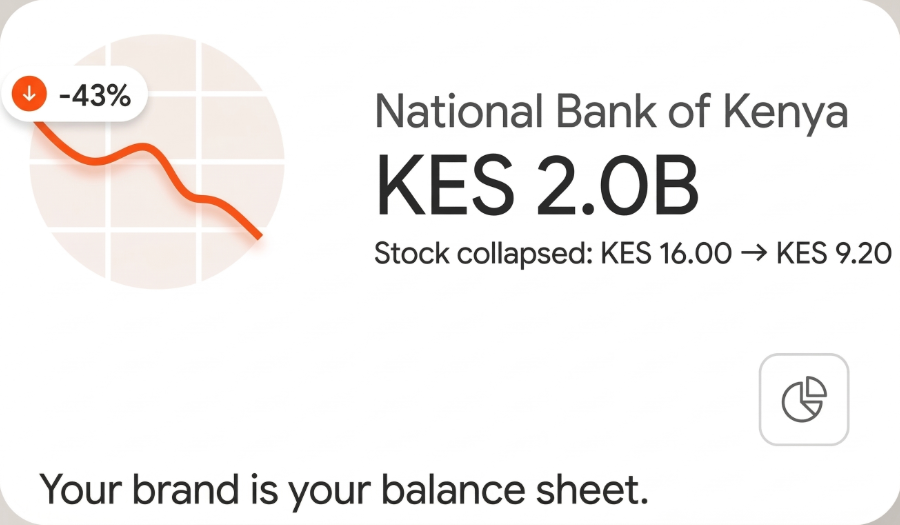
KES 2.0B
NATIONAL BANK OF KENYA
Stock collapsed from KES 16.00 to KES 9.20. When an institution loses its public narrative, equity destruction is immediate.
Your brand is your balance sheet.
Receivership
MUMIAS SUGAR
Decades of operational dominance erased. When governance signals deteriorate, the market punishes. Operational strength cannot save a collapsed narrative.
Restructuring Spiral
UCHUMI SUPERMARKETS
A national giant paralyzed. The collapse was accelerated by the absence of a credible narrative to hold investor trust. Perception became the margin of failure.
What Closing The Gap Actually Delivers.
Equity Bank Fixed The Gap. Here Is What Happened Next.
Equity Bank Stopped Looking Like A Local Lender. They Aligned Their Brand Architecture With Their Pan-African Scale. The Financial Results Were Transformational.
+14
%
Profit after tax growth, reaching KES 22.6 billion in the exact same financial year of the architectural alignment.
+11
%
Customer base expansion to 13.9 million accounts. This wasn’t driven by a marketing campaign; it was driven by structural alignment.
+23
%
Massive loan book growth to KES 366.4 billion as institutional trust and global investor perception surged.
“Your brand is not separate from the balance sheet. It is reflected in it.”
Areas of Practice.
What your organisation depends on to operate and grow.
Everything you need to know
How do I make my company look credible to institutional investors in Kenya?
The gap between what an established Kenyan company has built and what an institutional investor perceives is almost always an infrastructure gap, not a performance gap. Investors conducting due diligence evaluate four things: financial performance, operational capability, governance structure, and institutional credibility. The first three are your job. The fourth is what Jukwaa builds. Specifically, this means a brand architecture that reads at the correct institutional tier, governance documentation formatted for investor data rooms — board profiles at boardroom register, committee mandates, accountability frameworks — and an investor narrative that frames your operational track record as an investable thesis rather than a company history. The Equity Bank precedent is instructive: in 2019, when their brand architecture aligned with their operational scale, profit grew 14% and their loan book expanded 23% in the same financial year. The relationship between institutional presentation and capital outcomes is documented and direct.
What is institutional brand architecture and how is it different from regular branding?
Institutional brand architecture is the system that makes an organisation’s credibility legible to the audiences that determine its trajectory — investors, government procurement officers, regional partners, and senior enterprise clients. Regular branding optimises for recognition and consumer appeal. Institutional brand architecture optimises for due diligence. It is the difference between a brand that wins a design award and a brand that passes the scrutiny of a sovereign fund’s investment committee. For an established African company, this means a visual identity system that signals the correct institutional tier, governance documentation that reads as evidence rather than compliance, and a narrative framework that positions 10, 20, or 30 years of operational experience as strategic advantage rather than company background. A brand that reads as SME when the balance sheet says institution is not a cosmetic problem. It is a capital access problem.
Why do established Kenyan companies lose contracts to competitors with weaker operations?
The CEB/Gartner research on B2B procurement documents that 69% of the purchase decision is complete before a buyer contacts a vendor. This means your website, your search presence, your brand architecture, and your digital footprint are evaluated — and a shortlist is formed — before you are given the opportunity to present. An organisation with stronger operations but weaker institutional presentation is systematically eliminated from procurement processes it should be winning. The three specific gaps that cause this pattern in East Africa: a brand that signals smaller than the business actually is, a digital platform with measurable performance gaps that signal operational informality, and a discovery footprint that either does not exist or is dominated by content that underrepresents the organisation’s true scale. All three are infrastructure problems. All three are fixable.
How does Jukwaa help with governance documentation for East African companies?
Governance documentation is the structured evidence package that makes a board, a management structure, and an operational track record legible to institutional audiences. For an established African company, this typically includes board profiles written at boardroom register — not LinkedIn biographies, but formal institutional documentation that reads as evidence of governance seriousness — committee mandates, accountability frameworks, and the regulatory compliance documentation that a government procurement process or an investor data room requires. Jukwaa produces this documentation as part of the Define Authority pillar, always in context of the specific audience the documentation needs to serve. The governance documentation for a company seeking NSSF contracts reads differently from the documentation for a company seeking private equity investment, even if the underlying facts are the same. The framing determines how the evidence lands.
What is AI discovery and why does it matter for B2B companies in Kenya?
AI discovery refers to the process by which AI tools — ChatGPT, Perplexity, Google’s AI Overview — surface organisations as answers to business-relevant queries. When a procurement officer at a multinational asks ChatGPT which Kenyan companies have institutional-grade environmental compliance documentation, or when an investor asks Perplexity which East African manufacturers have the strongest governance track records, the organisations that surface as answers are not necessarily the best ones — they are the ones whose content is structured for AI citation. Kenya leads Africa in AI adoption with 96% of organisations having begun integration. Only 11% of B2B companies globally have content structured for AI discovery. 34% of qualified B2B leads are now sourced through AI-assisted search. For an established African company, AI discovery architecture is the difference between existing in the market and being the answer the market finds.
How long does it take to rebuild a company's institutional brand in Kenya?
The Stage Audit — Jukwaa’s forensic diagnosis of an organisation’s institutional gaps — is delivered within 14 days of engagement. The full infrastructure build, from brand architecture through platform and discovery, is deployed in a structured 60-day window. This timeline is not a creative schedule. It is an infrastructure deployment sequence: brand architecture first, narrative evidence second, platform third, discovery fourth. Each stage builds on the previous one, and the sequence matters because a discovery campaign landing on a weak brand produces no compounding return. The 60-day framework applies to the anchor engagement. Ongoing infrastructure — the discovery architecture that compounds over time, the executive media cadence that builds thought leadership, the platform optimisation that eliminates ongoing revenue leakage — operates on a continuous basis after the initial deployment.
Can Jukwaa help a company prepare for acquisition or investment?
Yes. Preparing for acquisition or investment requires a specific type of institutional infrastructure that most Kenyan companies have not built — because it is only urgently required at the point when a deal is already in progress, by which time the timeline to build it properly has closed. The institutional investment narrative is the document that positions an organisation’s operational track record as an investable thesis. The governance documentation suite is the evidence package that an investor’s due diligence team opens in a data room. The brand architecture is the first impression that tells the acquirer or investor whether this is an institution or an enterprise before any financials are reviewed. Jukwaa builds all three as part of the Define Authority pillar. The work is most effective when commissioned 90 to 180 days before a transaction process begins — not after the LOI is signed.
Own The Stage
The Stage Audit.
We map the gap between your operational scale and your institutional presentation before it costs you capital. We engineer the specific brand architecture, digital platforms, and discovery infrastructure required to close it. Zero generic playbooks. Only forensic, sector-specific intelligence.