The Short Answer:
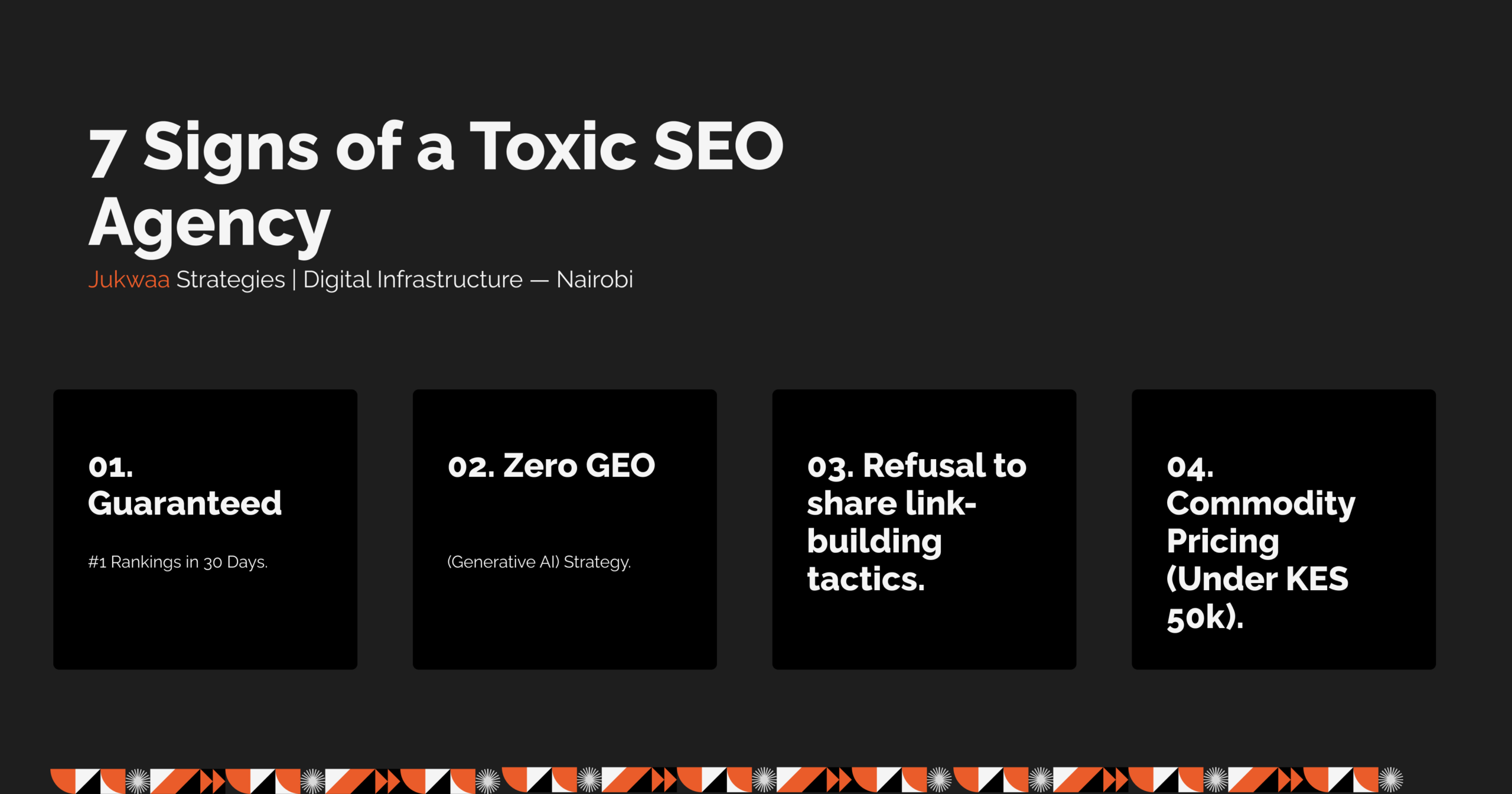
When vetting an SEO agency in Kenya, immediate disqualification red flags include: guaranteeing a #1 ranking within 30 days, failing to understand Generative Engine Optimization (GEO) for AI search, refusing to disclose their backlink acquisition strategies, and quoting commodity prices (under KES 50,000/month). A reputable corporate SEO firm will prioritize technical site architecture, entity schema markup, and measurable commercial ROI rather than vanity traffic metrics and black-hat manipulation.
For an established enterprise in East Africa, hiring the wrong Search Engine Optimization (SEO) agency does not just waste marketing capital, it actively destroys your corporate digital real estate.
The Kenyan digital marketing space is currently saturated with generalist agencies offering “SEO” as an add-on service. Many of these agencies rely on outdated, manipulative tactics that worked in 2015 but trigger catastrophic algorithmic penalties in 2026. If your domain is flagged by Google for spam policies, your corporate website is effectively erased from the internet. For a Tier-2 bank, a regional manufacturer, or a global entrant, this is an unacceptable operational risk.
If you are a Chief Marketing Officer, a CEO, or a procurement officer evaluating proposals, you must know how to separate legitimate institutional architects from commodity scammers.
How Do I Choose the Right SEO Company in Kenya?
Choosing the right SEO partner requires asking highly technical questions during the procurement phase. You are not hiring someone to “write blog posts”; you are hiring a technical partner to restructure your digital architecture so that Google and Artificial Intelligence models (like ChatGPT and Google AI Overviews) can read, understand, and cite your corporate data.
If an agency cannot explain their exact methodology for technical SEO, content engineering, and entity alignment, they are not equipped to handle an enterprise account.
To protect your balance sheet, watch closely for these 7 severe red flags during your vendor vetting process.
Red Flag 1: They “Guarantee” a #1 Ranking in 30 Days
This is the most common and dangerous lie in the digital marketing industry.
Google’s algorithm processes billions of data points, updates dynamically, and is now heavily influenced by personalized AI results. No external agency controls Google, meaning no agency can legally or technically guarantee a specific rank.
If an agency promises a #1 ranking in 30 days, they are either lying to close the sale, or they are using “Black Hat” tactics, such as buying thousands of toxic, spam backlinks to trick the algorithm. This will trigger a temporary spike in traffic, followed swiftly by a Google “Manual Action Penalty,” which will permanently blacklist your domain.
Red Flag 2: They Do Not Understand Generative Engine Optimization (GEO)
In 2026, traditional Google searches are only half the battle. Corporate clients and institutional investors are increasingly using generative AI engines (ChatGPT, Perplexity, Claude, and Google AI Overviews) to conduct due diligence and vendor comparisons.
If you ask a prospective agency, “What is your strategy for Generative Engine Optimization (GEO)?” and they look confused or dismiss it, end the meeting. An elite agency must know how to deploy “Entity Schema” and structure your data so that artificial intelligence models cite your company as the definitive industry answer.
Red Flag 3: Secretive or “Proprietary” Link-Building Practices
Backlinks (when other websites link to yours) are a massive signal of trust for search engines. However, the quality of those links matters entirely.
If an agency claims their link-building strategy is a “trade secret,” it is a severe red flag. They are likely using Private Blog Networks (PBNs) or buying links on compromised, low-quality websites in foreign countries. A legitimate agency will transparently tell you their strategy: Digital PR, securing citations in respected African business journals, and publishing high-value data that natural authoritative sites want to link to.
Red Flag 4: Commodity Pricing (The KES 20,000 Illusion)
High-end SEO requires senior technical developers to fix server issues, elite copywriters to engineer authoritative content, and PR specialists to acquire high-authority backlinks.
You cannot buy this level of expertise for KES 20,000 or KES 30,000 a month. Agencies offering commodity pricing are simply running automated audit tools, spitting out a generic PDF report, and doing zero structural work on your website. If the price seems too good to be true, it is because you are buying an automated report, not a digital infrastructure upgrade.
Red Flag 5: They Don’t Ask for Access to Your Web Developers
SEO is deeply technical. If an agency claims they are doing SEO for you but they never ask for access to your website’s backend, your CMS (Content Management System), or your lead developers, they are not doing real SEO.
A professional firm must address “Core Web Vitals.” They need to resolve CSS bloat, fix JavaScript rendering bottlenecks, optimize server response times, and implement schema markup. They cannot do this from the outside. If they aren’t touching your code, they are just guessing.
Red Flag 6: Reporting on “Vanity Metrics” Instead of Commercial ROI
When an agency sends a monthly report highlighting that “Impressions are up 400%,” ask them what those impressions actually mean for the balance sheet.
Bad agencies focus on vanity metrics: generic website traffic, impressions, and bounce rates. Good agencies focus on commercial reality: Marketing Qualified Leads (MQLs), B2B inquiry volume, and ranking improvements for highly specific, high-intent commercial keywords (e.g., “corporate asset finance in Nairobi” rather than just “finance”).
Red Flag 7: AI-Generated Content at Scale Without Human Editing
With the rise of generative AI, lazy SEO agencies are using ChatGPT to generate hundreds of generic, unedited blog posts and flooding their clients’ websites to artificially inflate page counts.
Google’s 2024 and 2025 “Helpful Content Updates” specifically target and penalize domains that publish unoriginal, low-value AI slop. An institutional agency uses AI for data analysis and outlining, but insists on human-led, expert-driven writing to ensure the content provides genuine “Information Gain” to the reader.
What Does a Good SEO Company Portfolio Look Like?
When evaluating an agency’s portfolio, do not look at how pretty the websites they built are. Look for documented, empirical data.
A premier agency’s case study should demonstrate:
- Technical Baseline: Where the client’s site speed and indexability started vs. where it finished.
- Strategic Focus: How they identified the high-intent keywords that actual buyers use.
- Measurable Outcomes: A clear transition from digital invisibility to capturing verified commercial leads or securing citations inside major AI engines.
The Jukwaa Standard: Secure Your Digital Sovereignty
At Jukwaa Strategies, we do not engage in generic consumer SEO. We build the sovereign digital infrastructure and execute the Generative Engine Optimization (GEO) that African Giants rely on to command market authority.
We operate with absolute technical transparency, ensuring your brand survives both algorithmic updates and the transition to AI search.
Commission a Digital Discoverability Audit with Jukwaa Strategies Today