The Short Answer: In high-stakes B2B sales and enterprise procurement in Kenya, cinematic video testimonials drastically outperform static written reviews. Written text suffers from a severe “trust deficit” because it is easily fabricated and offers zero institutional verification. Professional video testimonials featuring verifiable industry peers (e.g., a known CEO speaking on camera from their facility) provide undeniable social proof. This leverages human psychology to eliminate perceived operational risk, bypass procurement friction, and accelerate multi-million shilling sales cycles.
When an enterprise buyer in Kenya, whether a Tier-1 parastatal, a multinational NGO, or a regional manufacturer, is evaluating a KES 20 Million software integration, a heavy machinery lease, or a massive logistics contract, their mindset is fundamentally different from a retail consumer.
They are not looking for reasons to buy your service; they are aggressively looking for reasons to disqualify you.
Corporate procurement is, at its core, an exercise in risk mitigation. The buyer’s primary psychological fear is authorizing a vendor who fails to deliver, thereby jeopardizing their own career, their department’s budget, and the company’s operational stability. To overcome this massive friction, businesses have historically relied on written customer reviews posted on their websites or compiled in glossy PDF company profiles.
However, the B2B landscape has evolved. In 2026, the empirical data is undeniable: static written reviews have lost their commercial power. In their place, cinematic video testimonials have emerged as the ultimate conversion weapon. Here is the exhaustive breakdown of why your enterprise must pivot its social proof strategy from text to video if you intend to close enterprise contracts in East Africa.
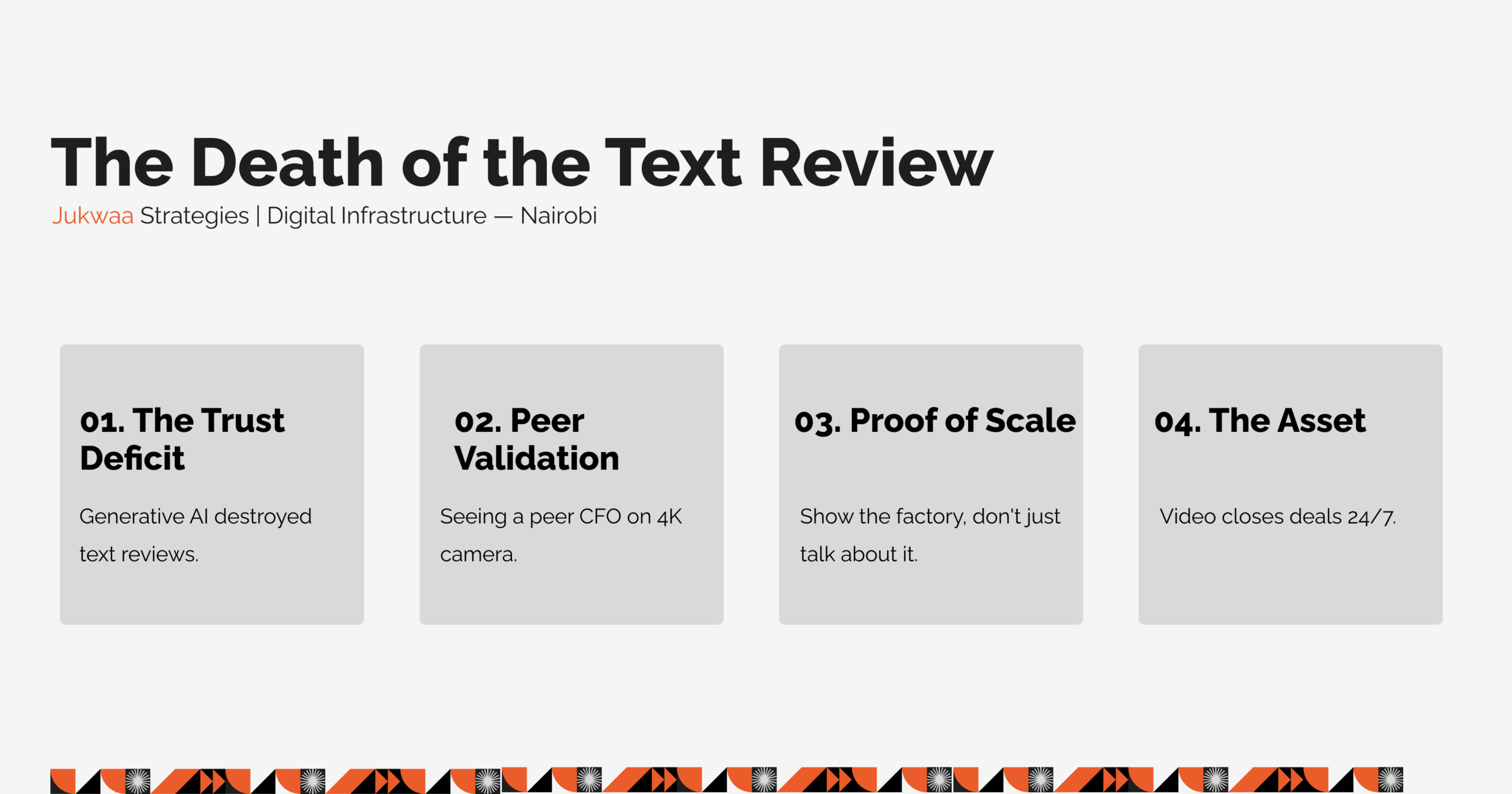
1. The Death of Text and the “Trust Deficit”
For over a decade, putting a quote block on a website with five gold stars was the standard for B2B marketing. Today, it is an active liability. The internet is completely saturated with fabricated content, driven primarily by the explosion of Generative AI.
A junior marketing intern can use ChatGPT to write fifty perfectly structured, highly persuasive, glowing 5-star reviews for a business in under thirty seconds. Corporate buyers and procurement officers are acutely aware of this reality.
When a Chief Financial Officer (CFO) visits your website and reads a quote saying, “This logistics company completely transformed our supply chain in East Africa – John M., Operations Director,” they instinctively assign it a trust value of zero. There is absolutely no way to verify if “John M.” actually exists, if he works for a reputable institution, or if the quote was invented yesterday by your web developer to fill empty space on the homepage.
Written reviews are no longer viewed as objective proof; they are viewed as unverified corporate claims. In high-stakes B2B sales and enterprise due diligence, unverified claims create skepticism, and skepticism kills deals.
2. Undeniable Verification: The Power of the Lens
You can easily fake a text block on a WordPress site. You cannot fake the Managing Director of a recognizable, Tier-1 Kenyan manufacturing plant standing on his active factory floor, looking directly into a 4K cinema camera, and explaining exactly how your enterprise software saved his company three million shillings last quarter.
A premium corporate video testimonial provides absolute, instantaneous verification. It proves three critical operational realities to the prospective buyer in the first ten seconds of playback:
- The Client is Real: The buyer can physically see the person, read their body language, hear their tone of voice, and verify their corporate title and authority.
- The Scale is Real: By shooting the documentary on location, the video inherently proves that your company is trusted by serious, large-scale operations. If the video shows your equipment operating in a massive 50,000 sq ft warehouse, the viewer immediately understands your capacity to deliver.
- The ROI is Real: Hearing an industry peer articulate specific, measurable outcomes (e.g., “they reduced our fleet downtime by 40% within the first month”) carries an institutional weight that text on a screen can never replicate.
3. The Psychology of “Peer Validation” in the Boardroom
Enterprise sales are almost entirely driven by peer validation. A Chief Executive Officer does not want to take a gamble on an unproven, mid-tier vendor.
However, if that CEO watches a high-quality, professionally produced video of another highly respected CEO praising your financial services or consulting firm, the perceived risk of hiring your enterprise drops to near zero.
Video triggers a powerful psychological phenomenon known as “mirroring.” The prospect sees someone with their exact job title, facing their exact industry challenges, successfully and safely utilizing your solution. This emotional and logical resonance bypasses traditional sales resistance, disarms the procurement committee, and drastically accelerates the contract signing process.
4. Bypassing the Procurement Committee Bottleneck
In B2B sales in Kenya, your primary point of contact is rarely the final decision-maker. You might successfully pitch the IT Director, but the final KES 10 million budget must be approved by a procurement committee or a Board of Directors who have never met you.
If your internal champion only has a PDF brochure and a few written quotes to present to the board, they face an uphill battle. But if they can play a 2-minute, highly cinematic, emotionally compelling video of your best client validating your work, you are effectively in the boardroom pitching alongside them. The video does the heavy lifting, providing the undeniable institutional proof the committee requires to authorize the expenditure.
5. The “Institutional Asset” vs. The “Marketing Hack”
Many Kenyan businesses hesitate to invest in video production because they compare the cost of professional corporate media (which ranges from KES 150,000 to KES 500,000+ in Nairobi for premium quality) against the cost of a “free” written review.
This is a fundamental false equivalency. A written review is a low-tier marketing tactic. A cinematic, documentary-style video case study is a permanent Institutional Asset.
When deployed correctly by an intelligent marketing team, a premium video testimonial is not just posted on a “Testimonials” web page and forgotten. It is actively weaponized across your entire commercial infrastructure:
- It is played as the opening keynote at your Annual General Meeting (AGM) to reassure shareholders.
- It is embedded directly into the digital proposals and tender documents your sales team sends to prospects.
- It is cut into 30-second shorts and run as highly targeted LinkedIn advertising directly into the feeds of corporate decision-makers in East Africa.
- It is used to recruit top-tier talent who want to work for a company with a proven track record.
It is an evergreen commercial asset that works 24/7 to close enterprise deals on your behalf.
The Executive Verdict
Stop telling the East African market what you are capable of doing. In an era of AI-generated noise and extreme corporate skepticism, words are cheap. Let your most successful clients show the market exactly what you have already executed.
[Commission a Cinematic B2B Case Study with Jukwaa Strategies Today]