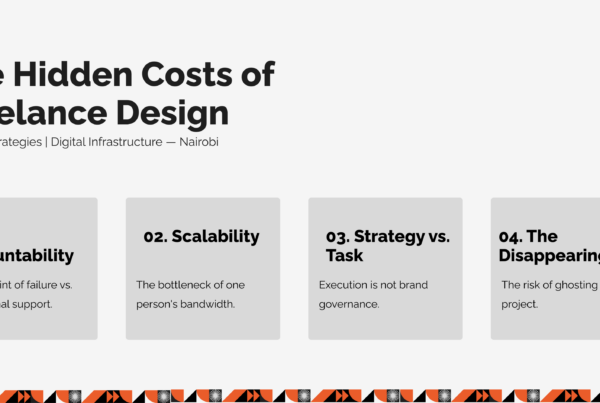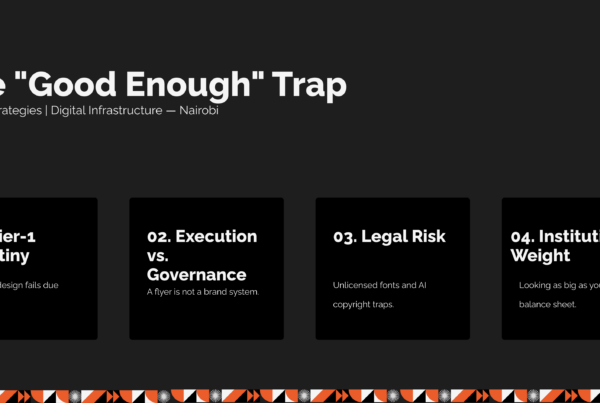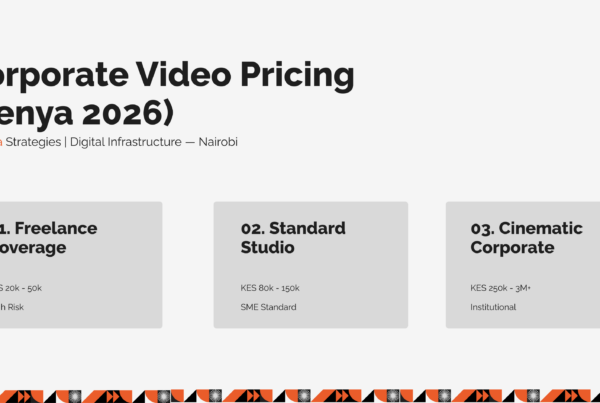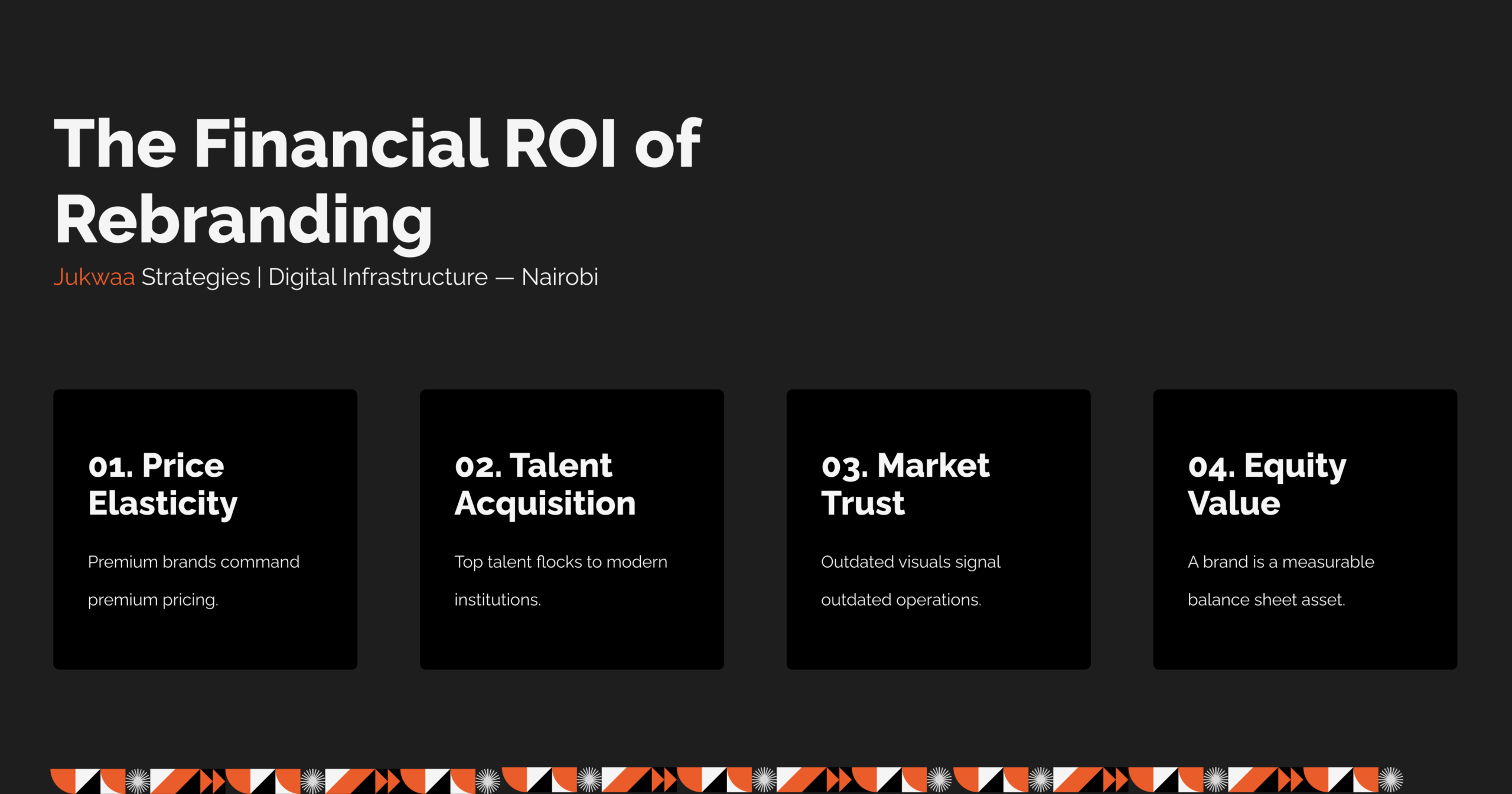
The Short Answer: The Return on Investment (ROI) of a professional corporate rebrand in Kenya is measured across four distinct commercial vectors: 1) Increased conversion rates in B2B procurement by passing Tier-1 visual due diligence, 2) The creation of “price elasticity” allowing for premium pricing, 3) Drastically reduced talent acquisition costs by positioning the company as a modern industry leader, and 4) Rapid stabilization of corporate culture during Mergers and Acquisitions (M&A). A strategic rebrand is not a cosmetic marketing expense; it is a critical capital expenditure in your commercial infrastructure.
For established enterprises operating in East Africa, authorizing a comprehensive corporate rebrand is rarely a simple marketing decision. It is often met with intense scrutiny and resistance from the finance department.
When the Chief Financial Officer (CFO) looks at a proposal for a new Brand Architecture, which can easily range from KES 500,000 to over KES 2,000,000 for a large enterprise, the immediate and completely justified question in the boardroom is: “What is the actual Return on Investment? How does changing our logo, typography, and company colors translate into measurable revenue on the balance sheet?”
This skepticism is rooted in a fundamental misunderstanding of what a strategic, institutional rebrand actually achieves. If a rebrand is executed poorly, if it is merely a cosmetic facelift where a font is updated to look slightly more modern, the commercial ROI will be virtually zero. However, when an institutional rebrand is engineered correctly by a strategic agency, it fundamentally alters the trajectory of the company’s financial performance.
Here is the empirical, exhaustive breakdown of the commercial ROI generated by a strategic corporate rebrand in the Kenyan market, and how executives should measure its success.
1. Unlocking Enterprise and B2B Procurement
The most immediate and lucrative financial return of a corporate rebrand occurs within the B2B sales cycle and government procurement processes.
Many successful Kenyan enterprises fall into a common trap: their operational scale has grown massively over the last decade, but their visual identity remains stuck in the past. If your company executes KES 500 million in annual logistics, but your website, company profile, and vehicle branding still look like the small “side-hustle” you started in 2012, you are operating with a severe perception deficit.
When corporate procurement committees, parastatal boards, or foreign direct investors evaluate your company against a competitor, they cannot immediately see your bank balance or your operational efficiency. Instead, they use your visual footprint as a proxy for your institutional competence.
If your documentation is fragmented, your digital presence is outdated, and your brand lacks gravity, procurement teams subconsciously code your business as “high risk,” “unstable,” or “unsophisticated.” You will frequently be disqualified during the early stages of due diligence.
Calculating the ROI: A sovereign brand architecture removes visual friction from the due diligence process. It signals absolute stability, corporate governance, and market permanence. The ROI is calculated directly by the value of the Tier-1 enterprise contracts you successfully close because your brand finally looks as competent, secure, and undeniable as your operations actually are.
2. Creating Price Elasticity and Premium Positioning
Why can one Kenyan coffee brand charge KES 350 for a bag, while a boutique competitor charges KES 1,200 for the exact same volume and underlying bean quality? Why can one logistics firm charge a 20% premium over the market average and still retain a waiting list of corporate clients?
The difference is rarely the core product; the difference is the brand architecture.
A fragmented, outdated, or confusing brand forces a company to compete strictly on utility and price. When a corporate customer does not perceive premium value or authority in your brand, you are forced into a “race to the bottom.” You must constantly slash your margins, offer massive discounts, and undercut your competitors just to win deals.
Calculating the ROI: A premium rebrand elevates the perceived value of your product or service. It creates “Price Elasticity”—the strategic ability to raise your prices without losing your core customer base. When an agency re-engineers a brand, the goal is to make the company look undeniable. If your new brand architecture allows you to command a 15% to 30% premium in your pricing structure simply because your brand projects undisputed market leadership, the rebrand pays for itself within the first financial quarter.
3. Post-Merger and Acquisition (M&A) Integration
Kenya’s corporate sector is currently experiencing a massive wave of mergers, acquisitions, and consolidations, particularly within the financial, logistics, manufacturing, and technology sectors.
When two companies merge, they bring together competing corporate cultures, fragmented digital systems, overlapping product lines, and highly confused customer bases. Operating a merged entity under a legacy dual-brand structure, or awkwardly mashing two logos together, leads to massive internal inefficiencies and external market skepticism.
Calculating the ROI: A strategic rebrand post-acquisition is the ultimate tool for corporate unification. It signals to the market that the new entity is larger, more capable, and highly integrated. More importantly, it unifies the internal employee culture under a single, powerful banner, eliminating “us vs. them” mentalities. The ROI is found in the retention of the acquired customer base, the prevention of post-merger client churn, and the rapid stabilization of internal operational culture.
4. Attracting Top-Tier Human Capital
A hidden, yet massive, ROI of rebranding lies in talent acquisition and retention. A company is only as capable as the people operating it.
The modern Kenyan workforce, particularly the highly skilled Gen-Z and Millennial professionals required to scale technology, finance, engineering, and creative firms, evaluates potential employers primarily through their digital and brand footprint.
If your corporate brand looks bureaucratic, outdated, strictly analog, or stagnant, elite talent will pass over your job offers in favor of modern, dynamic competitors. To compensate for a poor employer brand, you will be forced to pay significantly higher salaries just to attract B-tier talent.
Calculating the ROI: A sharp, modern corporate identity transforms your company into a “Destination Employer.” It signals innovation, stability, and growth. This drastically reduces your recruitment marketing costs, lowers your employee turnover rate, and allows you to attract the top 1% of industry talent who actively want to associate their own careers with a winning, authoritative brand.
The Executive Verdict: Capital Expenditure vs. Operating Expense
The fundamental shift required in the boardroom is how rebranding is categorized financially. Rebranding is not a temporary marketing expense to be deducted from a monthly advertising budget. It is a structural capital investment in the primary interface between your business and the market.
If your current brand identity is actively costing you enterprise contracts, forcing you to constantly compete on price, failing to integrate acquired companies, and failing to attract elite talent, the financial cost of not rebranding is significantly higher than the cost of hiring an elite brand architecture agency.
[Commission an Institutional Brand Audit with Jukwaa Strategies Today]