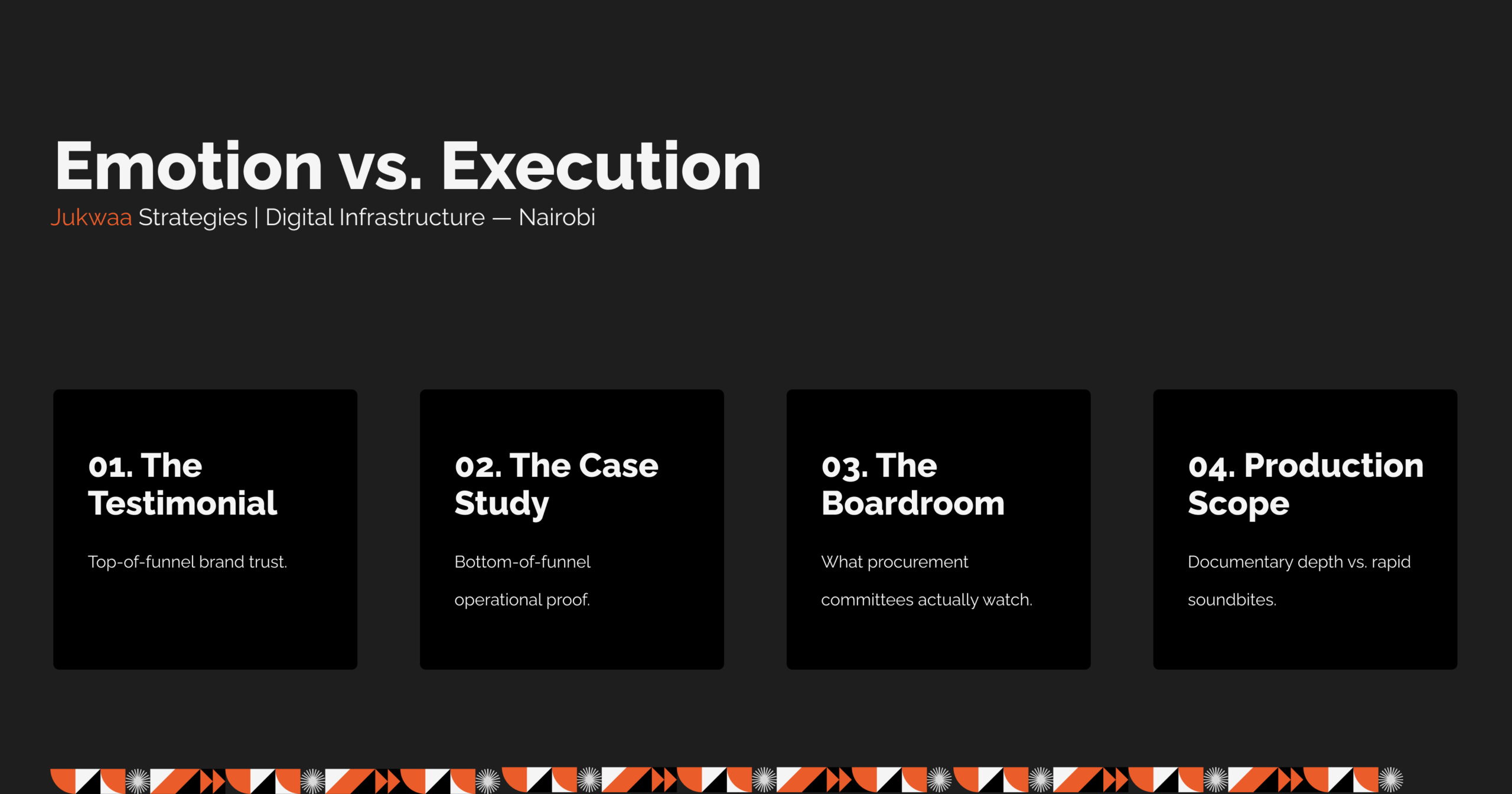
The Short Answer: While often used interchangeably by marketing departments, Customer Testimonials and Corporate Case Studies serve entirely different functions within the B2B sales funnel. A Testimonial is a brief, emotional endorsement designed to build top-of-funnel brand trust and humanize your enterprise. A Case Study is a deep, forensic documentary that details the exact operational problem, the implementation process, and the measurable financial ROI of your solution. To dominate enterprise procurement in Kenya, your business needs both: Testimonials to capture attention, and Case Studies to close the contract.
When a Kenyan enterprise, whether a national logistics firm, a Tier-2 bank, or a heavy machinery leasing company, decides to invest capital into corporate media production, the executive mandate passed down to the marketing team is usually straightforward: “We need to get our best clients on camera to say how great we are so we can win more tenders.”
The marketing agency then rushes out, films a few quick interviews, stitches them together with upbeat corporate background music, and posts the resulting video on LinkedIn. Invariably, the video generates a few polite “likes” from internal staff, but fails entirely to move the needle on actual B2B lead generation or procurement conversion.
Why? Because the company failed to understand the structural difference between a Testimonial and a Case Study, deploying the wrong asset to the wrong audience at the wrong time.
If you are allocating budget for corporate media in Nairobi, you must understand how to engineer these two distinct assets. Here is the definitive breakdown of how Testimonials and Case Studies operate in the East African B2B sales cycle.
1. The Anatomy of the Video Testimonial (The “Hook”)
The Video Testimonial is your top-of-funnel awareness tool. Its primary objective is not to explain your product; its objective is to generate immediate trust and humanize your corporate brand.
- The Vibe: Emotional, energetic, and highly relatable.
- The Length: Very short. Typically 30 to 60 seconds.
- The Content: It focuses almost entirely on the feeling of working with your company. The client will say things like, “The team was incredibly responsive,” “They saved us so much stress,” or “I highly recommend them to anyone in the industry.”
- The Deployment: Testimonials belong on social media (LinkedIn, X, Instagram), at the top of your website homepage, and in broad digital advertising campaigns.
The B2B Limitation: Testimonials are fantastic for getting a prospect to click your link and realize you are a legitimate company. However, if a procurement officer is evaluating a KES 50 million contract, a 30-second video of someone saying “they are great to work with” is not enough evidence to authorize the budget.
2. The Anatomy of the Corporate Case Study (The “Closer”)
The Corporate Case Study is your bottom-of-funnel conversion weapon. Its primary objective is to provide forensic, undeniable proof of operational execution and financial ROI. It is built to satisfy the rigorous due diligence of a boardroom.
- The Vibe: Authoritative, analytical, and cinematic. It looks and feels like a premium mini-documentary.
- The Length: Longer format. Typically 2 to 4 minutes.
- The Content: A Case Study follows a strict narrative arc:
- The Problem: The client explains the severe operational bottleneck or financial bleeding they were experiencing before they met you.
- The Implementation: They detail how your company stepped in, the complexity of the deployment, and your specific technical expertise.
- The ROI (The Climax): They deliver hard, verified numbers. “They reduced our supply chain latency by 45%,” or “They increased our overall yield by KES 12 Million in the first quarter.”
- The Deployment: Case Studies belong deep inside your commercial infrastructure. They are embedded in your service landing pages, attached to digital tender proposals, emailed directly to highly qualified leads by your sales team, and played as keynotes in B2B pitch meetings.
The B2B Advantage: When a procurement committee watches a high-fidelity Case Study, their primary fear, the risk of vendor failure, is eliminated. They have just watched a forensic breakdown of exactly how you successfully solved their exact problem for an industry peer.
3. The Production Differences: How They Are Filmed
Because they serve different purposes, a professional media agency approaches the production of these two assets completely differently.
Filming the Testimonial: Production is usually rapid. It can often be shot in a single location, such as a client’s office or even a quiet conference room after an event. The lighting is clean and bright, and the interview questions are designed to elicit quick, soundbite-friendly answers about customer satisfaction.
Filming the Case Study: Production is highly complex and requires “Corporate Journalism.” An elite agency will schedule a multi-location shoot. If you sold software to a logistics company, the agency will film the CEO in the boardroom, but they will also deploy cinema cameras and drones to film the software actively working on the warehouse floor and managing the truck fleet. This B-roll (supplementary footage) is critical; it provides the visual proof of scale that enterprise buyers demand. The interview process is much deeper, designed to extract exact metrics, challenges overcome, and strategic insights.
4. The Hybrid Strategy: The “Hero” Asset
For enterprises operating with intelligent marketing budgets, the optimal strategy is not choosing one over the other, but producing both simultaneously through a “Hero Asset” framework.
When you hire a premium agency like Jukwaa Strategies for a case study shoot, the primary deliverable is the 3-minute cinematic documentary (The Closer). However, the agency will also take the best emotional soundbites from that exact same shoot and edit them down into three or four separate 30-second Testimonial snippets (The Hooks).
This allows your enterprise to launch the short testimonials on LinkedIn to grab attention, which then funnel the viewer directly to your website to watch the full, heavy-hitting case study that ultimately closes the deal.
The Executive Verdict
If your sales team is struggling to close large corporate tenders because prospects “need more time to think about it,” they are suffering from a trust deficit. You do not need to lower your prices; you need to increase your proof. Equip your enterprise with the cinematic case studies required to dominate the boardroom.
[Commission a Corporate Documentary with Jukwaa Strategies Today]