The Short Answer: Choosing between a freelance graphic designer and a brand design agency in Kenya depends entirely on your operational scale, legal risk tolerance, and commercial objectives. A freelancer is ideal for rapid, low-budget graphic execution (flyers, social media posts, basic logos) where institutional risk is minimal. However, a brand agency is an absolute mandate for established SMEs and enterprises that require comprehensive corporate identity systems, sovereign intellectual property protection, market gap analysis, and the structural design architecture required to pass Tier-1 corporate procurement due diligence.
For business owners, Chief Executive Officers, and Marketing Directors operating in Nairobi, the procurement of design services often feels like navigating a chaotic and unregulated minefield. The Kenyan market is heavily saturated with creatives. On one side of the spectrum, you have individual freelancers on platforms like Upwork, or local creatives pitching basic logo designs for KES 5,000 on Instagram. On the opposite end, you have institutional brand architecture agencies presenting comprehensive corporate identity proposals exceeding KES 500,000.
The immediate and highly justified question that corporate executives ask is: “Why should my company pay an agency a premium of half a million shillings when a talented freelancer can draw me a logo by tomorrow morning for a fraction of the cost?”
This confusion stems from a fundamental misunderstanding of what is actually being purchased. When you hire a freelancer, you are buying a picture. When you hire an agency, you are buying the visual infrastructure that will represent your enterprise to international investors, government parastatals, and Tier-1 corporate clients.
Here is the definitive, exhaustive breakdown of the Freelancer vs. Agency debate, the hidden legal and operational risks of cheap design, and how to determine which commercial model your business actually requires in the 2026 East African market.
1. The Scope of Delivery: Graphic Execution vs. Brand Architecture
The most significant and measurable difference between a freelancer and an agency is the depth, scale, and strategic intent of the final deliverable.
The Freelancer Model: Transactional Graphic Execution Freelancers typically operate on a highly transactional, execution-based model. Their primary objective is to fulfill your immediate request as quickly as possible. If you tell a freelancer you need a logo featuring a blue mountain and modern text, they will draw you exactly that. They are focused on the immediate aesthetic output.
If you need a quick social media poster for a weekend sale, a menu for a new local restaurant, or a logo for a personal side-hustle, a talented freelancer is the most cost-effective and rapid solution available. They excel at isolated tasks.
The Agency Model: Sovereign Brand Architecture Institutional agencies do not just execute design; they architect corporate identities. Before an agency designer even opens their software, a dedicated brand strategist conducts a forensic “Market Gap Analysis.” They analyze your top five competitors in East Africa, studying their color palettes, typography, and market positioning to ensure your new brand identity visually disrupts the market rather than blending into it.
Furthermore, an agency does not merely deliver a logo file; they deliver a Brand Standards Manual. This is a comprehensive, restrictive governance document—often spanning 40 to 60 pages—that dictates exact typography hierarchies, primary and secondary color hex codes, and strict rules for how the brand must be applied across diverse environments. It covers everything from how your logo looks on a mobile app icon, to how it is painted on a massive logistics warehouse, to how it is embroidered on employee uniforms. This architecture ensures absolute, unwavering consistency as your company scales nationally or regionally.
2. Institutional Risk and Legal Due Diligence
When you are a growing enterprise bidding for massive government tenders, securing supply chain contracts with FMCG giants, or seeking venture capital, your brand undergoes severe due diligence. Your visual identity is treated as a corporate asset, and its legal standing must be bulletproof.
The Hidden Legal Risk of the “Cheap” Logo Many low-cost freelancers operate with extremely high volume to make a living. To achieve this, they frequently utilize pre-made templates, stock vector websites, or increasingly, unedited Generative AI to create logos rapidly.
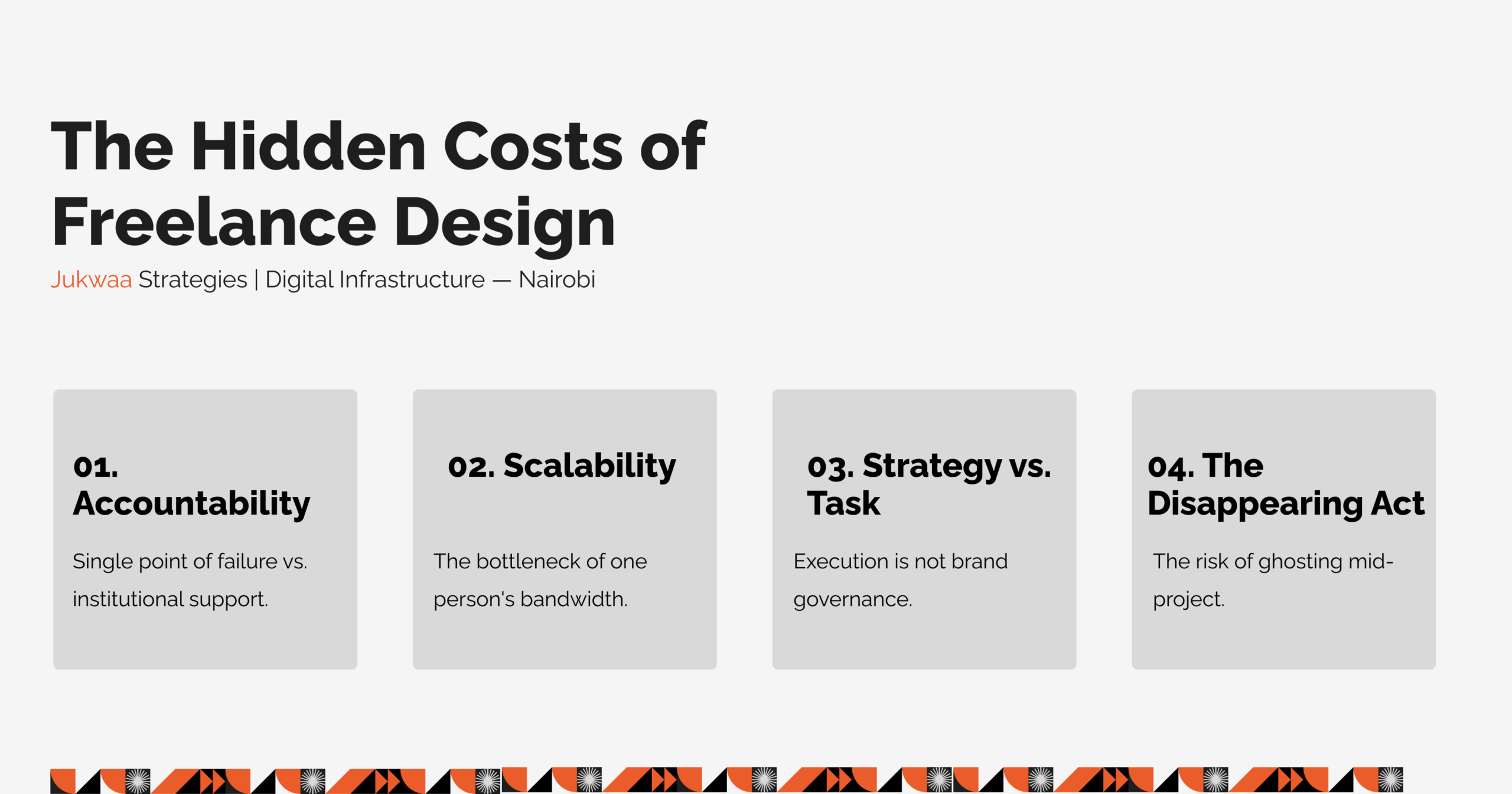
The legal risk here is catastrophic for a growing business. If your freelancer inadvertently (or deliberately) sells you a slightly modified version of a copyrighted logo, or uses a font they do not have a commercial license for, your business cannot legally trademark that identity. If you scale your company, print physical packaging, and launch marketing campaigns using stolen or unlicensed intellectual property, you expose your entire balance sheet to future litigation. A KES 5,000 logo can easily result in a KES 5,000,000 lawsuit.
The Agency Guarantee of Sovereignty Professional branding agencies operate with strict legal indemnities and operational compliance. Every primary brand asset is built from scratch as sovereign intellectual property. Agencies ensure that the typography used is legally commercially licensed for enterprise use, and that the logo mark is legally defensible in the Kenyan intellectual property market.
When an enterprise pays a premium for an agency, they are not just paying for prettier colors. They are paying for operational insurance and the absolute guarantee of unencumbered digital ownership.
3. The “Bus Factor” and Operational Continuity
Corporate marketing and brand management are continuous, ongoing operations. A brand is not built in a day and forgotten; it requires ongoing collateral generation, from annual shareholder reports to exhibition booth designs and quarterly campaign rollouts.
The Freelancer Bottleneck (The “Bus Factor”) In corporate risk management, the “Bus Factor” refers to the risk a company faces if their key service provider becomes suddenly unavailable (e.g., “gets hit by a bus”). When your enterprise relies entirely on a single freelance designer, your entire visual output comes to a grinding halt if that individual falls ill, takes a full-time job, suffers a laptop failure, or simply decides to stop responding to emails. For a corporate entity with strict campaign deadlines and tender submission requirements, this operational bottleneck is completely unacceptable.
The Agency Redundancy Advantage An agency provides institutional continuity and built-in redundancy. When you hire an agency, you are hiring a structured team comprising an Account Director, a Lead Brand Strategist, a Senior Art Director, and multiple Junior Designers.
If one designer takes leave or falls ill, your account management continues uninterrupted because the institutional knowledge is shared. Furthermore, the agency holds your historical design files on secure, enterprise-grade, backed-up servers. This ensures that your corporate profile can be updated instantly, whether it is three days or three years after the initial rebrand. You are buying permanent operational stability.
4. Passing Tier-1 Procurement and Due Diligence
In the B2B sector, visual identity is a proxy for operational competence.
If your enterprise has scaled operations over the last decade, but your visual identity, letterheads, and company profiles still look like they were designed by a novice in 2014, you face a severe perception deficit in the boardroom.
When corporate procurement committees, parastatal boards, or foreign direct investors evaluate your company against a competitor, they look for visual friction. If your company profile is poorly formatted, your website is fragmented, and your logo lacks institutional gravity, procurement teams instinctively code your business as “high risk” or “unstable.” They will disqualify you before they even evaluate your pricing or technical capabilities.
A freelance logo cannot solve a systemic perception deficit. An agency restructures your entire outward-facing identity so that when you walk into a boardroom to pitch a KES 100 million contract, your brand commands the exact same weight as your operational capabilities.
5. The Final Procurement Decision: How to Choose
The decision matrix is ultimately quite simple:
- When to Hire a Freelancer: If your total budget is strictly under KES 30,000, your primary objective is launching a small, localized business rapidly, and you do not foresee bidding for corporate contracts in the next 24 months, hire a highly-rated local freelancer. Ensure you demand high-resolution vector files (AI, EPS) and written confirmation that the work is 100% original.
- When to Hire an Agency: If your business is doing tens of millions in turnover, if you are pitching B2B services to procurement committees, if you are planning an international expansion, or if you are preparing for a merger or acquisition, a freelancer cannot provide the institutional weight you require. You must hire a firm capable of building a legally sovereign, strategically disruptive brand architecture.
Your brand is your company’s most visible asset. Treat its procurement with the same rigor you would apply to your legal or financial infrastructure.
[Initiate an Institutional Brand Architecture Audit with Jukwaa Strategies Today]