The Short Answer: While free DIY tools like Canva are sufficient for solo-preneurs and local side-hustles, they are actively destructive to the institutional credibility of established B2B enterprises. Relying on DIY design or cheap freelancers in Kenya exposes your company to severe legal IP risks, operational bottlenecks, and immediate disqualification during corporate due diligence. Hiring a professional Brand Architecture agency ensures your visual identity projects undisputed market authority, protects your intellectual property, and guarantees the structural consistency required to win Tier-1 procurement contracts in East Africa.
In 2026, the barrier to creating a “pretty picture” is lower than ever before. With the explosion of user-friendly platforms like Canva and the rapid advancement of Generative AI image tools, anyone with a laptop and an internet connection can generate a logo, a social media poster, or a basic company profile in minutes, entirely for free.
This technological shift has prompted many Chief Financial Officers (CFOs) and business owners in Nairobi to ask a very logical question: “If my marketing intern can use Canva to make our flyers for free, why should the enterprise pay a professional design agency hundreds of thousands of shillings for corporate branding?”
This question stems from a fundamental misunderstanding of what graphic design actually is at the enterprise level.
If you are running a weekend bake sale or a localized retail shop, DIY tools are perfectly acceptable. But if you are a logistics firm, a regional manufacturer, or a financial institution bidding for multi-million shilling corporate contracts, DIY design is an operational liability. Here is the exhaustive breakdown of why African Giants abandon DIY tools and invest heavily in professional Brand Architecture.
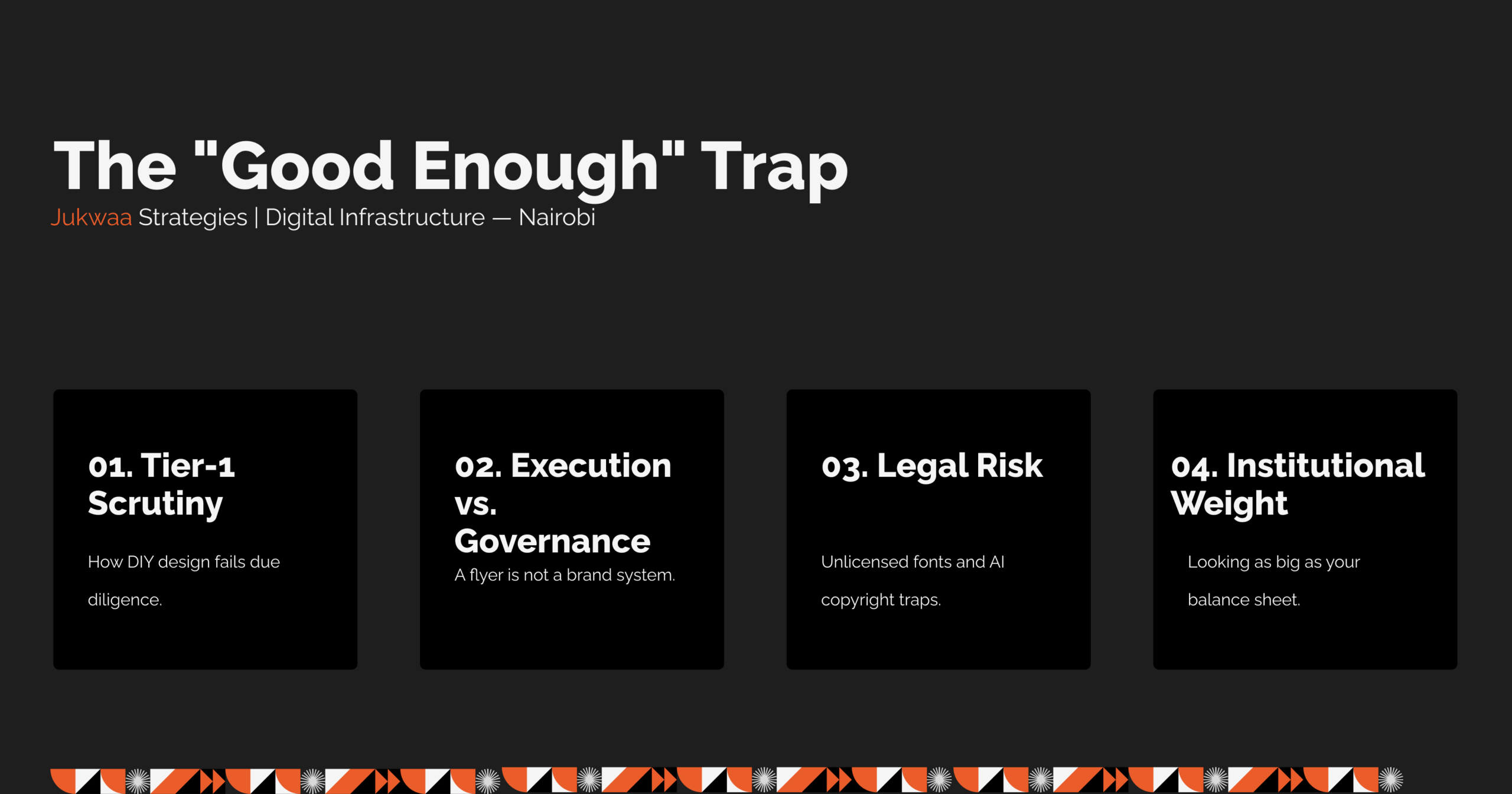
1. Passing Tier-1 Due Diligence (The Visual Friction Trap)
In the high-stakes B2B sector, your visual identity is a proxy for your operational competence.
When a corporate procurement committee, a foreign direct investor, or a government parastatal evaluates your company against a competitor, they do not immediately see your bank balance or your factory floor. They see your company profile, your website, and your pitch deck.
If your documentation looks like it was stitched together using generic Canva templates, with inconsistent fonts and misaligned logos, procurement teams instinctively code your business as “high risk,” “unstable,” or “unsophisticated.” This is called “Visual Friction.”
Corporate buyers are highly attuned to quality. They know what a free template looks like. If you cut corners on your own corporate identity, the buyer assumes you will cut corners on their multi-million shilling contract. A professional design agency removes this friction, ensuring your brand commands the exact same institutional weight as your operational capabilities.
2. Graphic Execution vs. Brand Governance
The biggest difference between a DIY user (or a cheap freelancer) and a professional agency is the scope of the deliverable.
A DIY tool provides Graphic Execution. It helps you make a single, isolated image for a Tuesday Instagram post.
A professional agency provides Brand Governance. When an enterprise hires an agency, they do not just get a logo; they receive a comprehensive Brand Standards Manual. This is a restrictive, 50-page architectural document that dictates exact typography hierarchies, primary and secondary color hex codes, and strict mathematical rules for how the brand must be applied across every environment.
This governance ensures that your brand looks exactly the same whether it is printed on a massive billboard on Mombasa Road, embroidered on an employee uniform, or displayed on a mobile app. DIY tools inherently breed fragmentation; professional agencies engineer absolute, scalable consistency.
3. The Hidden Legal and IP Risks of DIY Design
When an enterprise scales, its visual identity becomes a legally protected corporate asset.
The DIY/Template Risk: Many DIY platforms operate on shared asset libraries. If you build your company logo using a generic template icon from Canva or a free stock website, you cannot legally trademark that logo in Kenya, because thousands of other users have the exact same rights to that icon. Furthermore, if an untrained employee uses a font they do not have a commercial license for in a major advertising campaign, your company exposes its balance sheet to severe copyright litigation.
The Agency Sovereignty: Professional brand agencies operate with strict legal indemnities. Every primary brand asset is built from scratch as sovereign intellectual property. Agencies ensure that all typography is legally licensed for enterprise commercial use, and that the logo mark is fully defensible in the Kenyan intellectual property market. You are buying legal insurance, not just aesthetics.
4. Operational Continuity and the “Bus Factor”
Corporate marketing is a continuous, high-pressure operation. You have urgent tender submissions, quarterly shareholder reports, and rapid campaign rollouts.
If your entire visual output relies on one junior employee using Canva, or a single cheap freelancer you found online, your business suffers from a massive bottleneck. If that individual falls ill, takes leave, or simply stops responding to emails, your corporate communications come to a grinding halt.
An agency provides institutional continuity and built-in redundancy. You are backed by an Account Director, a Lead Strategist, and multiple Senior Designers. Your historical design files are held on secure, enterprise-grade servers. If you need an urgent update to a pitch deck at 8:00 AM on a Monday, the agency executes it flawlessly, regardless of which specific designer is at their desk. You are buying permanent operational stability.
The Executive Verdict
Graphic design at the enterprise level is not about making things look “pretty.” It is about engineering trust, ensuring legal compliance, and projecting undeniable market dominance. Stop treating your brand identity as an intern’s side project, and start treating it as the multi-million shilling corporate asset it is.
[Initiate an Institutional Brand Architecture Audit with Jukwaa Strategies Today]