The Short Answer:
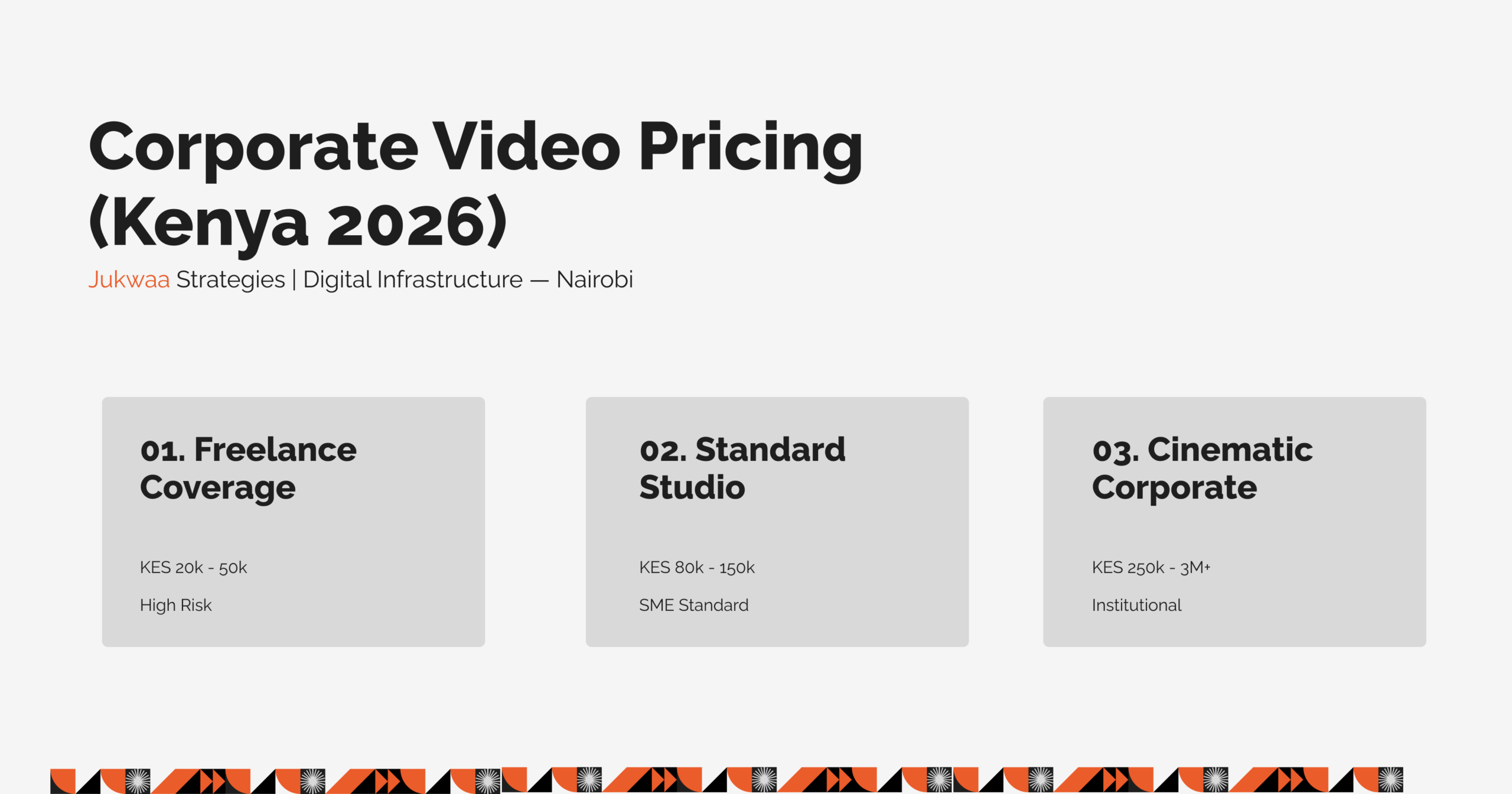
In 2026, corporate video production in Nairobi ranges from KES 20,000 for basic freelance event coverage to between KES 250,000 and KES 3,000,000+ ($1,940 – $23,250+) for broadcast-quality, 4K cinematic corporate documentaries and TV commercials. For a standard, high-quality corporate profile video from a mid-tier production house, businesses should budget between KES 80,000 and KES 150,000 depending on crew size, equipment, and post-production requirements.
In the modern digital economy, a corporate video is the closest most of your clients and investors will ever get to walking through your front doors.
If you are a Tier-2 bank, a regional manufacturer, or a global enterprise entering East Africa, your video assets must reflect the scale of your balance sheet. A poorly lit, badly edited corporate video does not just look cheap—it actively signals operational incompetence to procurement officers and institutional investors.
If your marketing department or board of directors is evaluating video vendors, you must understand the pricing mechanics of the Kenyan market. Here is a definitive guide to what video production costs in Nairobi, and what you are actually paying for.
How Much Does Professional Video Production Cost in Kenya?
The Kenyan media landscape is heavily saturated, meaning you will receive wildly different quotes for the exact same brief. The market is split into three distinct tiers based on risk, equipment, and narrative capability.
Tier 1: The Freelance Videographer (KES 20,000 – KES 50,000)
At this tier, you are hiring a single operator, usually shooting on a DSLR or mirrorless camera.
- What you get: One camera angle, basic natural lighting, and a direct edit of what happened.
- The Risk: This tier is suitable for basic social media content or internal team events. However, single operators cannot manage complex lighting, multi-channel audio, and directing corporate executives simultaneously. If you use a KES 20,000 video to pitch a KES 100 Million project, the aesthetic disconnect will destroy your credibility.
Tier 2: The Mid-Level Production House (KES 80,000 – KES 150,000)
This is the standard tier for SMEs and local NGOs. You are hiring a small crew (a director/camera operator, an audio technician, and an editor).
- What you get: Better lighting setups, clean lapel-mic audio, decent B-roll (cutaway footage), and basic color correction.
- The Risk: While technically proficient, mid-level production houses often lack business acumen. They know how to operate cameras, but they do not know how to structure an institutional narrative that appeals to corporate treasurers and global stakeholders.
Tier 3: Cinematic Corporate Production (KES 250,000 – KES 3M+)
This is the institutional standard. At Jukwaa Strategies, we do not shoot “videos”; we produce cinematic corporate assets designed to capture mass market authority.
- What you get: A full production pipeline. Raw 4K/60fps cinema cameras, professional grip and lighting trucks, drone operators, and premium post-production color grading. More importantly, you get a dedicated creative director who scripts a narrative engineered to achieve a specific commercial outcome (like raising capital or repositioning a brand).
- The Value: Absolute visual dominance. When an investor watches a Tier 3 documentary, they immediately recognize the company as an African Giant.
Pricing Comparison Matrix: Video Production in Kenya
| Production Tier | Estimated Cost (KES) | Crew Size | Best Suited For |
|---|---|---|---|
| Freelance Operator | KES 20K – 50K | 1 Person | Social media snippets, basic event recaps. |
| Mid-Level Studio | KES 80K – 150K | 2-3 People | SME company profiles, internal training videos. |
| Cinematic Production | KES 250K – 3M+ | Full Crew | Investor documentaries, national TVCs, global market entry. |
What Should I Budget for a Corporate Video? (Cost Factors)
When an agency quotes KES 500,000 for a 3-minute corporate documentary, executives often ask where the money goes. Video production pricing is dictated by hard technical and logistical variables:
- Pre-Production and Scripting: The most critical phase. This covers strategy meetings, scriptwriting, location scouting, and storyboarding. If you skip pre-production, you are paying to film a disorganized concept.
- Crew and Equipment Day Rates: Cinema-grade cameras (like RED or ARRI), professional lighting kits, and stabilized gimbals are expensive to rent and insure. Furthermore, you are paying day rates for specialized personnel: Directors of Photography (DoP), Gaffer (Lighting), and Sound Recordists.
- Post-Production (Editing & Grading): Editing is only 30% of post-production. The remaining 70% is professional sound mixing (removing background noise and leveling dialogue), licensing premium royalty-free music, and color grading (making the footage look like a movie rather than a home video).
- Logistics: Transporting equipment and crew to remote locations (e.g., shooting an agricultural cooperative in Nakuru or a factory in Athi River) adds travel, accommodation, and per-diem costs.
Why Do Video Production Prices Vary So Much?
Prices vary because agencies sell different products. A freelancer sells their time with a camera. An institutional agency sells the commercial outcome of the video.
The most severe mistake corporate teams make is prioritizing video resolution over audio quality. Bad video with great audio is a documentary. Great video with bad audio is unwatchable. Mid-tier agencies cut costs by relying on camera-mounted microphones. Elite agencies deploy dedicated sound recordists to ensure your CEO sounds commanding and authoritative.
The Hidden Costs of Cheap Video Production
Opting for the cheapest video quote often results in a total loss of capital. If a video is delivered with echoing audio, blown-out lighting, and off-brand messaging, it cannot be published. You will be forced to discard the asset and hire a professional agency to reshoot the entire project.
Furthermore, cheap production wastes your most valuable resource: your executive team’s time. You cannot ask a Managing Director to take three hours out of their schedule for an interview, only to throw the footage away because the freelancer failed to mic them properly.
Build Visual Authority with Jukwaa Strategies
If you are preparing to communicate a major corporate transition, launch a new enterprise product, or pitch to institutional investors, you cannot afford visual compromise.
Jukwaa Strategies builds the visual infrastructure that established African companies use to dominate their markets.
Contact Jukwaa Strategies to discuss your Cinematic Corporate Production today.