The Short Answer:
A professional corporate brand identity package in Kenya should include far more than a logo. It must deliver a complete visual governance system: primary and secondary logo lockups, defined typography hierarchies, strict color psychology mapping (CMYK, RGB, HEX), social media asset structures, and a comprehensive Corporate Identity Manual (Brand Guide) to enforce visual consistency across all physical and digital touchpoints.
In the East African corporate sector, the difference between an SME and an established institution is visual discipline.
When global companies expand into Kenya, or when African enterprises pitch to international investors, their visual assets are subjected to intense scrutiny. A fragmented brand, where the website uses one font, the letterhead uses another, and the logo is stretched on social media, signals operational incompetence to a procurement desk.
To prevent this, businesses must stop buying “logos” and start investing in Brand Architecture. Here is exactly what you should demand from a rebranding agency in Kenya.
Branding vs. Logo Design: What’s the Difference?
A logo is merely a symbol, a single graphic mark used to identify a business.
Branding (Brand Identity) is the complete operational system that surrounds that logo. It dictates how your company looks, sounds, and feels across every medium. A logo without a brand identity system is like a door without a building. It leaves your internal teams and external vendors guessing how to present your company, inevitably leading to a cheap, disjointed public appearance.
What’s Included in a Professional Brand Identity Package?
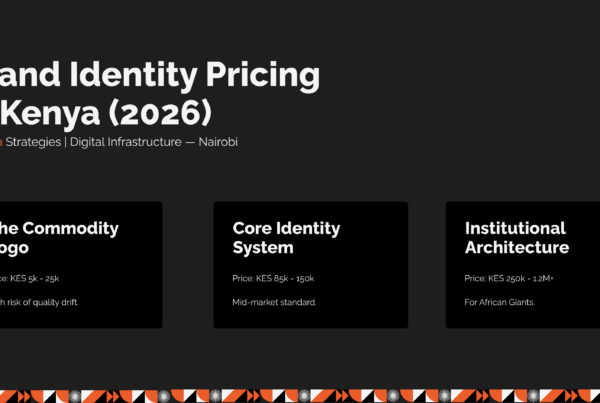
If you are investing in a mid-tier Core Identity System (typically KES 85,000 – KES 150,000 in Nairobi), your graphic design agency must deliver the following foundational assets:
- Master Logo Lockups: The primary logo, horizontal/vertical variations, and simplified single-color (monochrome) versions for restrictive printing.
- Typography Hierarchy: Specific licensed fonts for H1 headers, body text, and corporate documents.
- Color Architecture: Exact color codes extracted for print (CMYK/Pantone) and digital (HEX/RGB) to prevent colors from looking “washed out” on different screens.
- File Sovereignty: Delivery of all raw, high-resolution vector source files (.AI, .EPS, .SVG) so you own your intellectual property.
What Does a Brand Guide (Corporate Identity Manual) Include?
For holding companies and institutional players investing in full Brand Architecture (KES 250,000 – KES 1.2M+), the most critical deliverable is the Corporate Identity Manual.
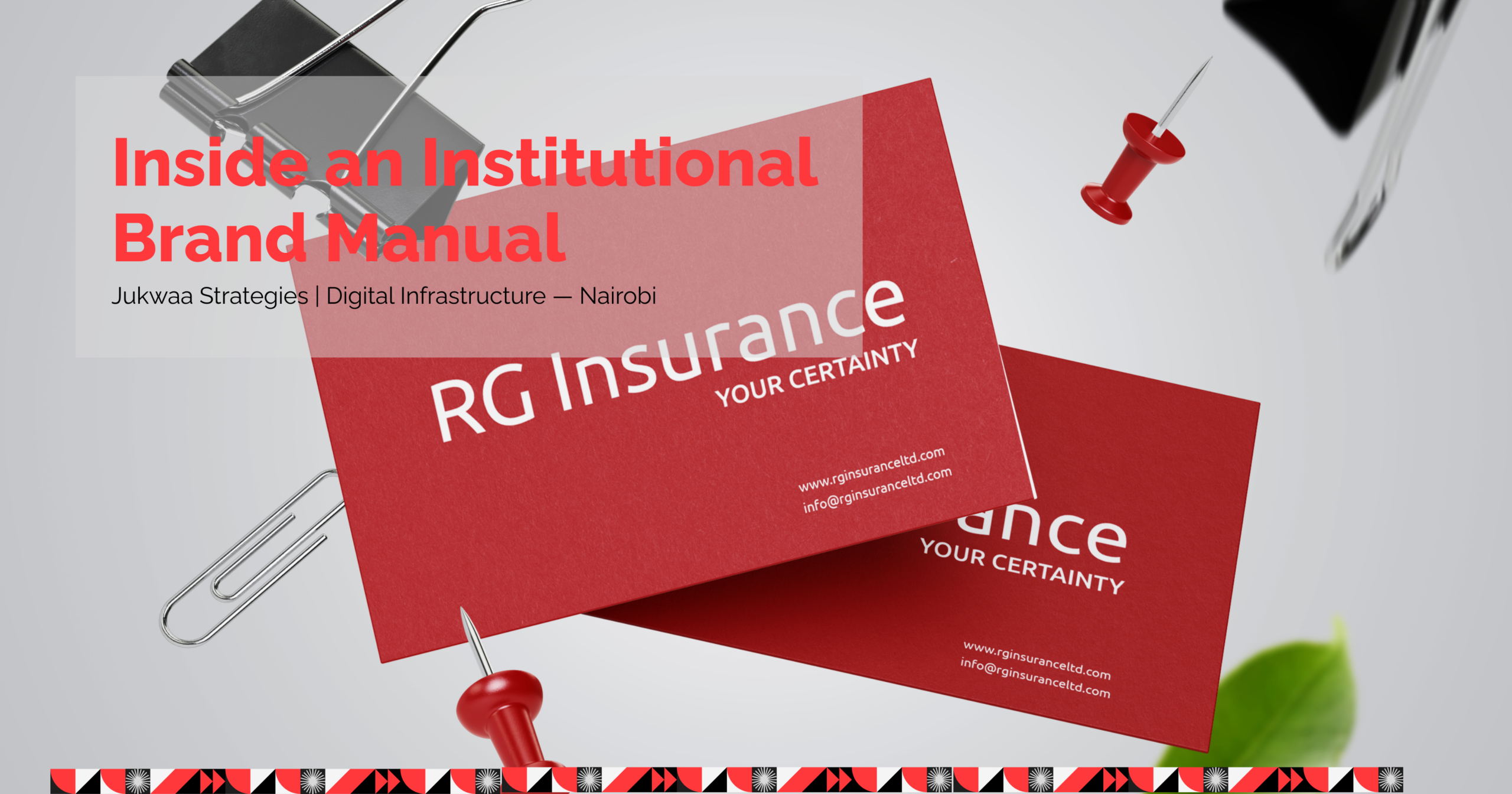
At Jukwaa Strategies, we build this as a 50+ page governance document. It is the rulebook your marketing teams and vendors must follow. It includes:
- Clear Space & Exclusion Zones: Mathematical rules dictating how close other elements can get to your logo.
- Parent-Subsidiary Mapping: Visual rules for how holding companies relate to their sub-brands without causing market confusion.
- Executive Boardroom Assets: Standardized, high-end templates for business cards, gold-foil letterheads, and investor pitch decks.
- Improper Usage Rules: Explicit visual examples of what not to do with the brand (e.g., no stretching, no unauthorized drop shadows).
- Tone of Voice (The “Peter Persona”): Guidelines on how the brand speaks to stakeholders, ensuring external communications sound authoritative and institutional.
Build Infrastructure for Trust
Africa rewards preparation and punishes assumptions. If your revenue and operational reach say “African Giant,” but your visual identity says “startup,” you are losing capital to competitors with better brand governance.
Do not commission a logo design company when you need an institutional architect.
3 Costly Mistakes Kenyan Businesses Make with Brand Packages
When transitioning from an SME to a corporate entity, executives often procure brand identity packages without knowing how to audit the final deliverables. This leads to three common structural failures:
1. The CMYK / RGB Disconnect
A generic designer will give you one color code (e.g., a HEX code for web). When you send that exact same color to a printing press in Industrial Area for your corporate folders or billboards, it comes out muddy, dark, or entirely the wrong shade.
- The Institutional Fix: A professional brand package must deliver color architecture separated into CMYK (for physical print), RGB (for digital screens), and Pantone (for exact industrial color matching). This guarantees your brand looks identical on a smartphone and on a 40-foot highway billboard.
2. Ignoring the “Exclusion Zone”
You will often see local company logos crammed tightly next to partner logos on sponsorship banners, making them look cheap and cluttered.
- The Institutional Fix: A Corporate Identity Manual establishes an “Exclusion Zone” (or Clear Space). This is a mathematical rule, often measured by the height of a specific letter in your logo, dictating exactly how much empty space must surround your logo at all times. It forces third-party vendors to give your brand the breathing room it requires to look premium.
3. Missing Typography Governance
Typography is the subconscious voice of your business. If your official documents use Arial, your website uses Roboto, and your social media uses Comic Sans, your brand lacks governance.
- The Institutional Fix: A professional package dictates your primary display font (for headers), your secondary text font (for long documents), and the exact weight (Bold, Medium, Light) required for each.
How Long Does It Take to Build a Corporate Identity System?
Institutional architecture cannot be rushed over a weekend. If an agency promises a full brand package in 48 hours, they are using templates. A genuine corporate identity system requires a rigorous, phased timeline:
- Phase 1: The Brand Audit & Strategy (7 – 10 Days) Before any design begins, your agency must audit your current market positioning, competitor visual footprints, and your target audience demographics. This phase determines the psychological direction of the brand.
- Phase 2: Visual Architecture & Lockups (10 – 14 Days) This is the structural design phase where the primary logo, secondary variations, and typography hierarchies are engineered and stress-tested across digital and physical mockups.
- Phase 3: The Governance Manual & Rollout (7 – 10 Days) The final phase involves compiling the 50+ page Corporate Identity Manual, designing the executive boardroom stationery, and preparing the exact file formats (.EPS, .AI, .SVG, .PNG) required for handover.
In total, expect a professional corporate rebrand to take 3 to 5 weeks from the initial kickoff to the final handover of the intellectual property.
Book a Stage Audit with Jukwaa Strategies Today