The Short Answer:
A high-converting corporate testimonial video does not pitch your product, it documents your client’s success. The most effective B2B video testimonials follow a strict 3-act narrative structure: quantifying the initial operational pain, detailing the strategic intervention, and verifying the measurable financial or operational ROI. To execute this without damaging client relationships, companies must frame the video shoot as a co-branded “thought leadership” feature rather than a vendor favor.
In the East African B2B and institutional markets, trust is the ultimate currency. A corporate treasurer, a parastatal CFO, or a multinational expansion director does not authorize a multi-million shilling invoice based on a clever advertising slogan. They authorize capital based on verified social proof.
While written case studies and Google reviews establish baseline credibility, nothing accelerates a complex enterprise sales cycle faster than a cinematic, high-fidelity testimonial video from a respected industry peer.
However, most corporate testimonials fail. They feel scripted, awkward, and overly promotional. If you are preparing to leverage your best clients for case studies, you must understand the psychology and production mechanics of high-converting social proof.
Video Testimonials vs. Written Reviews: Which Converts Better?
In consumer retail (B2C), a high volume of written reviews on platforms like Google Business Profile or Trustpilot is sufficient to drive sales. In enterprise and institutional sales (B2B), the dynamic completely changes.
The Limitations of Written Reviews in B2B:
Written reviews are frequently anonymous, brief, and easily fabricated. When a procurement desk is vetting a KES 5,000,000 software integration or a major infrastructure contract, a five-star text review reading “Great service, highly recommend” carries zero institutional weight.
The Power of Video Testimonials:
Video testimonials convert at a significantly higher rate in enterprise sales because they provide verifiable human accountability. When a recognizable CEO or Operations Director sits in front of a 4K cinema camera and stakes their personal professional reputation on your service, it completely neutralizes the buyer’s perceived risk. Video allows prospective clients to read body language, hear authentic tone, and see the physical environment of the success story.
What Makes a Good Corporate Testimonial Video?
A common mistake Kenyan businesses make is treating a testimonial like a TV commercial. A good testimonial is not an advertisement; it is a documentary-style case study.
The most effective corporate testimonials share three structural characteristics:
1. Absolute Authenticity (No Scripts)
Never ask a client to read from a teleprompter or memorize a script. Scripted praise sounds defensive and artificial. Instead, a professional production agency will use an experienced off-camera interviewer to conduct a natural, guided conversation. The best soundbites come from genuine, unscripted reflections on how your company solved their specific problem.
2. Contextual B-Roll (Supporting Footage)
A video of a person talking to a camera for three minutes is visually fatiguing. High-converting videos intercut the interview with “B-roll”—high-quality supplementary footage showing the client’s business in action. If the client is a manufacturer, show their factory floor. If they are an agricultural cooperative, show the harvest. B-roll proves that the client is a real, operational powerhouse, which by extension elevates your brand’s status for having them as a client.
3. Metric-Driven Outcomes
Generic praise (“They are great to work with”) is forgettable. Institutional buyers want data. A high-converting video guides the client to speak in metrics: “Before we hired them, we were losing 30% of our inventory. Within six months of integration, that dropped to 4%, saving us KES 12 Million.”
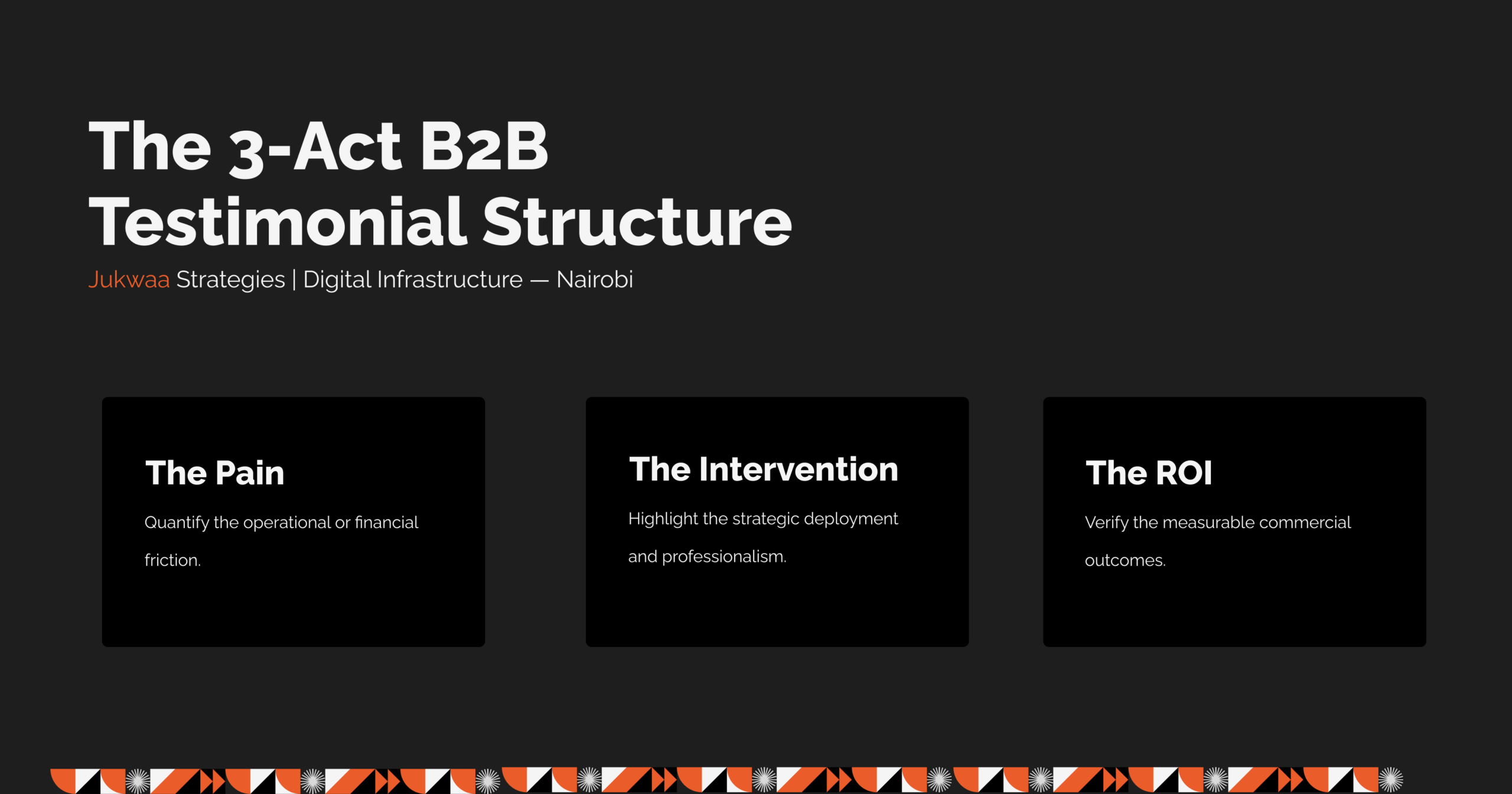
The 3-Act Structure of a B2B Testimonial
To extract these metric-driven soundbites naturally, your production team must structure the interview around a classic 3-Act narrative:
- Act I: The Pain (The Before): The video must begin by establishing the severity of the client’s problem before they hired you. What was bleeding revenue? What was causing operational friction? This makes your prospective clients realize, “We are facing that exact same problem right now.”
- Act II: The Intervention (The Pivot): The client describes the experience of working with your team. This is where they highlight your professionalism, speed of deployment, and strategic competence.
- Act III: The ROI (The After): The climax of the video. The client explicitly states the commercial return on investment, leaving the viewer with an undeniable proof of value.
How to Ask Customers for Video Testimonials (Without Being Awkward)
The biggest barrier to creating video case studies is the fear of asking. Executives worry that asking a high-value client to take time out of their day to film a video feels like begging for a favor.
The Institutional Fix: Frame it as Thought Leadership.
Do not ask your client to “do a testimonial for us.” Invite them to be featured in an industry spotlight or a “Leadership Profile Series” that your company is producing.
Approach them with this framing: “We are producing a high-end cinematic series profiling the most innovative companies in East Africa. Given the massive growth your team has achieved this year, we would love to feature you and your facility in a 3-minute professional documentary. We will cover all production costs, and you will have full access to the final 4K video to use for your own corporate marketing.”
This framing shifts the dynamic. You are no longer asking for a favor; you are offering them a free, KES 500,000 cinematic brand asset that elevates their own corporate profile.
Why High-End Production Value is Non-Negotiable
If you convince a Tier-1 CEO to give you two hours of their time, you cannot show up with a smartphone and a ring light.
Putting a corporate executive in front of cheap equipment is highly disrespectful to their brand and yours. You must deploy professional cinematic lighting, multiple 4K camera angles, and dedicated sound recordists. The quality of the video production subconsciously tells the viewer how valuable the client is.
At Jukwaa Strategies, our Cinematic Corporate Production team handles end-to-end testimonial creation—from securing the executive interview to final color grading. We build the visual proof that African Giants use to dominate their markets.
Contact Jukwaa Strategies to discuss your Cinematic Corporate Production today.