The Short Answer:
An established enterprise should rebrand only when its current visual identity no longer reflects its operational scale, when expanding into new regional markets, or following a major merger or acquisition. To rebrand without losing existing customers, leadership must execute a phased transition strategy that preserves core heritage elements while communicating the new institutional capability, rather than executing an abrupt, unannounced aesthetic change.
In East Africa, legacy is a double-edged sword.
A company that has operated successfully for 15 years possesses immense trust and market share. However, as that company scales from a local SME into a regional powerhouse or prepares for institutional investment, its original brand identity often becomes its biggest liability.
When your balance sheet says “African Giant,” but your visual identity says “1990s startup,” you create a credibility gap that competitors will exploit.
If you are a CEO or Board Director considering hiring a rebranding agency in Kenya, you must approach the transition not as a marketing campaign, but as a strategic infrastructure upgrade.
Do I Really Need to Rebrand My Business? (The Triggers)
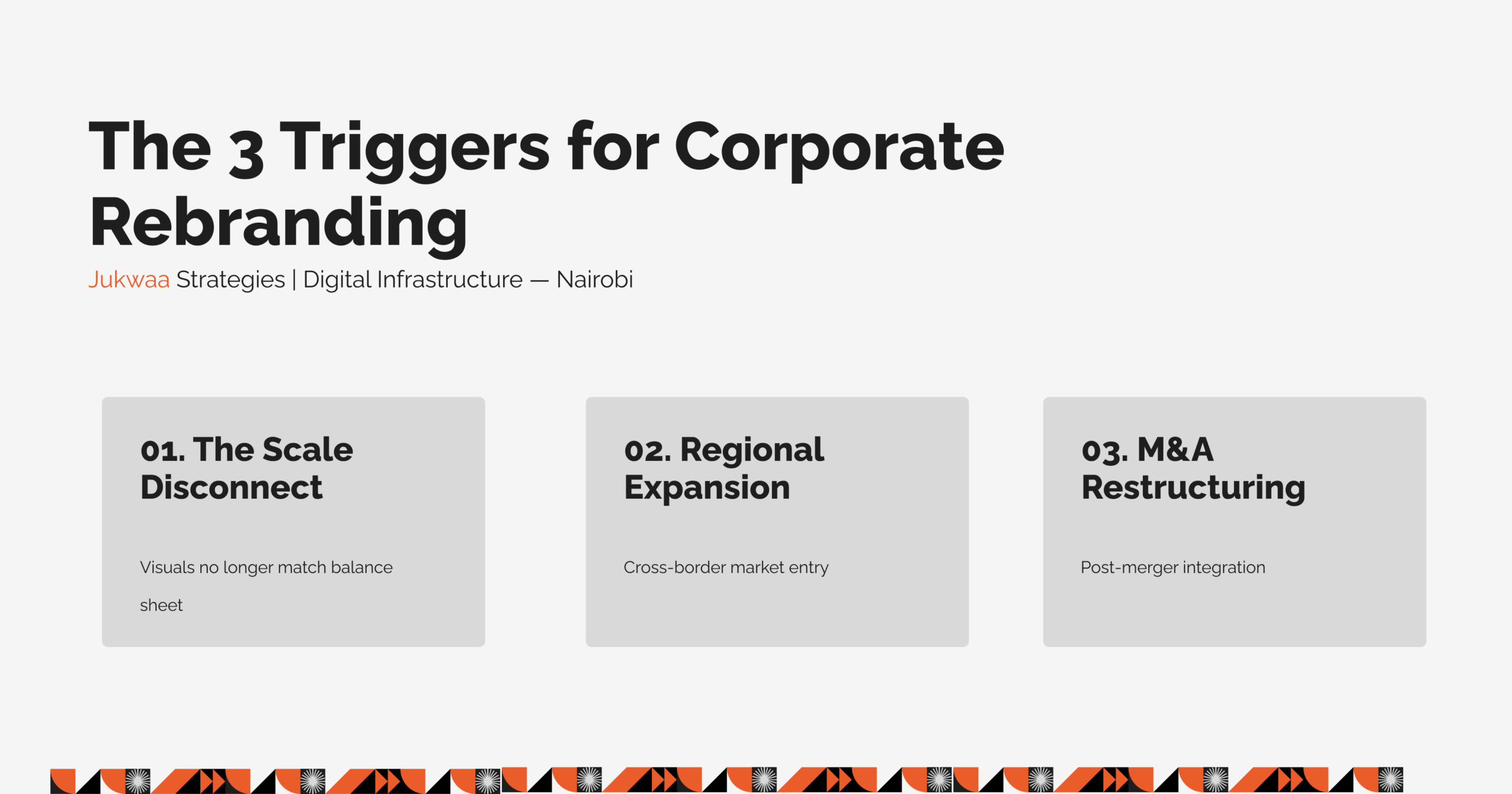
Rebranding is an expensive, high-risk operational maneuver. You should not rebrand simply because leadership wants a “fresh look.” You should authorize a rebrand only when triggered by one of these three structural shifts:
- The Scale Disconnect: Your service quality, pricing, and target market have evolved, but your visual identity still attracts low-tier, price-sensitive clients.
- Regional Expansion: You are moving beyond Kenya. A brand name or logo that works perfectly in Nairobi might carry negative cultural connotations or trademark conflicts in Kampala or Kigali.
- Mergers, Acquisitions, or NOHC Restructuring: Like the recent transitions in the Kenyan banking sector, a merger requires a new unified visual governance system to prevent operational ambiguity and corporate client attrition.
What is the ROI of Rebranding Your Business?
A rebrand is not an expense; it is a capital investment designed to yield specific returns. When executed correctly by an institutional brand architect, the ROI is measured in three ways:
- Premium Pricing Authority: A modernized, institutional brand allows you to command higher margins without encountering price resistance.
- Talent Acquisition: Top-tier executive talent gravitates toward organizations that project stability and modern governance.
- Investor and Procurement Trust: An institutional brand passes due diligence effortlessly, accelerating enterprise sales cycles and unlocking access to global capital.
Can I Rebrand Without Losing My Existing Customers?
Yes, but only if you manage the narrative. The greatest risk in corporate rebranding is alienating the legacy customers who built your foundation. They view a sudden, unannounced logo change not as an upgrade, but as a hostile takeover or an erasure of the company they trusted.
To prevent capital flight, you must bridge the gap between the old identity and the new capability.
How to Communicate a Rebrand to Your Customers
A visual design agency will change your logo. A strategic brand architect will manage your transition narrative.
- The Institutional Heritage Campaign: Do not launch the new brand with generic advertising. Launch it with a narrative campaign that honors the past while explaining the necessity of the future. (e.g., “For 15 years, we built the foundation. Now, we are building the future.”)
- Tiered Stakeholder Briefings: Mass-market customers should not receive the news at the same time as your largest corporate clients. Your top 20% of clients (and institutional investors) require personalized briefings before the public launch to ensure they understand their accounts and relationships are secure.
- Preserve the Core: A successful rebrand often updates the typography, color architecture, and digital infrastructure while preserving a subtle nod to the original heritage symbol. Evolution, not erasure.
The 3 Hidden Risks of Corporate Rebranding (What Agencies Don’t Tell You)
Visual design agencies focus entirely on aesthetics, the logo, the colors, and the launch party. However, for a mature African enterprise, a rebrand is a structural operational shift. If you ignore the backend mechanics of a rebrand, you will trigger severe commercial friction.
Here are the three hidden risks your transition team must mitigate:
1. The SEO and Digital Death Drop
When you change your company name, you usually change your website domain (URL). If an agency simply deletes the old site and launches the new one, you will instantly lose 100% of the organic search traffic and digital authority you built over the last decade.
- The Institutional Fix: A strategic brand architect executes a surgical 301 Redirect Mapping and updates your Entity Schema. This tells Google and AI engines (like ChatGPT) that your new brand is the exact same legal entity as the old brand, transferring your historical trust to the new domain without dropping a single rank.
2. Procurement and Legal Friction
Your legacy corporate clients have your current name and bank details hardcoded into their ERP and procurement systems. If you send an invoice with a new logo and name without managing the legal transition, their finance departments will flag it as fraudulent and freeze your payments.
- The Institutional Fix: Transition communications must include formal, notarized Vendor Update Packets. These packets must be delivered directly to the CFOs and procurement heads of your Top 20% clients, containing updated KRA PINs, CR12s, and bank letters, ensuring zero disruption to your cash flow.
3. Internal Cultural Rejection
If your front-line staff and relationship managers find out about the rebrand at the same time as the general public, the transition will fail. Staff who feel erased by a rebrand will subconsciously project that resentment to your customers, creating a disjointed brand experience.
The Institutional Fix: Internal marketing is just as critical as external marketing. You must execute an “Internal Launch” 30 days prior to the public reveal. Staff must be trained on the new “Tone of Voice” and understand why the transition protects their jobs and scales the company.
Protect Your Legacy
Rebranding a legacy African enterprise requires surgical precision. A mismanaged transition can destroy decades of brand equity overnight.
At Jukwaa Strategies, we build the institutional infrastructure that protects your market share during critical transitions.