The Short Answer: For B2B enterprises and institutional service providers in Kenya, Generative Engine Optimization (GEO/SEO) delivers a vastly superior, compounding long-term ROI compared to Google or Meta Ads. While Paid Advertising provides immediate, temporary visibility, it imposes a punishing “Click Tax”, the moment your budget runs out, your visibility drops to absolute zero. Institutional SEO builds permanent, sovereign digital real estate, allowing your enterprise to capture high-intent procurement traffic 24/7 without paying per click, fundamentally lowering your Customer Acquisition Cost (CAC) over time.
When the annual marketing budget is finally approved for a Kenyan enterprise, the Chief Marketing Officer (CMO) and the executive board face an immediate, high-stakes strategic crossroads: Should we deploy our capital into Paid Advertising (Google PPC, LinkedIn, Meta Ads) for instant gratification, or should we invest in Search Engine Optimization (SEO) for long-term dominance?
In the highly competitive East African B2B sector, where procurement cycles are long, contract values are high, and corporate due diligence is rigorous, the difference between renting attention and owning digital infrastructure dictates the profitability of your entire sales operation.
Here is the definitive, data-driven breakdown of SEO versus Paid Ads, the hidden costs of the pay-per-click model, and why African Giants are pivoting heavily toward Generative Engine Optimization (GEO) in 2026.
1. The Economic Model: The “Click Tax” vs. Sovereign Real Estate
The fundamental economic difference between Paid Ads and SEO is how the digital asset is owned and scaled.
The Paid Ad Reality (Renting Attention): Google Ads and Meta Ads operate on a Pay-Per-Click (PPC) or Pay-Per-Impression model. If you want to appear at the very top of Google for a highly lucrative commercial keyword like “Heavy Machinery Leasing Nairobi,” you must pay Google a premium fee every single time a user clicks your link.
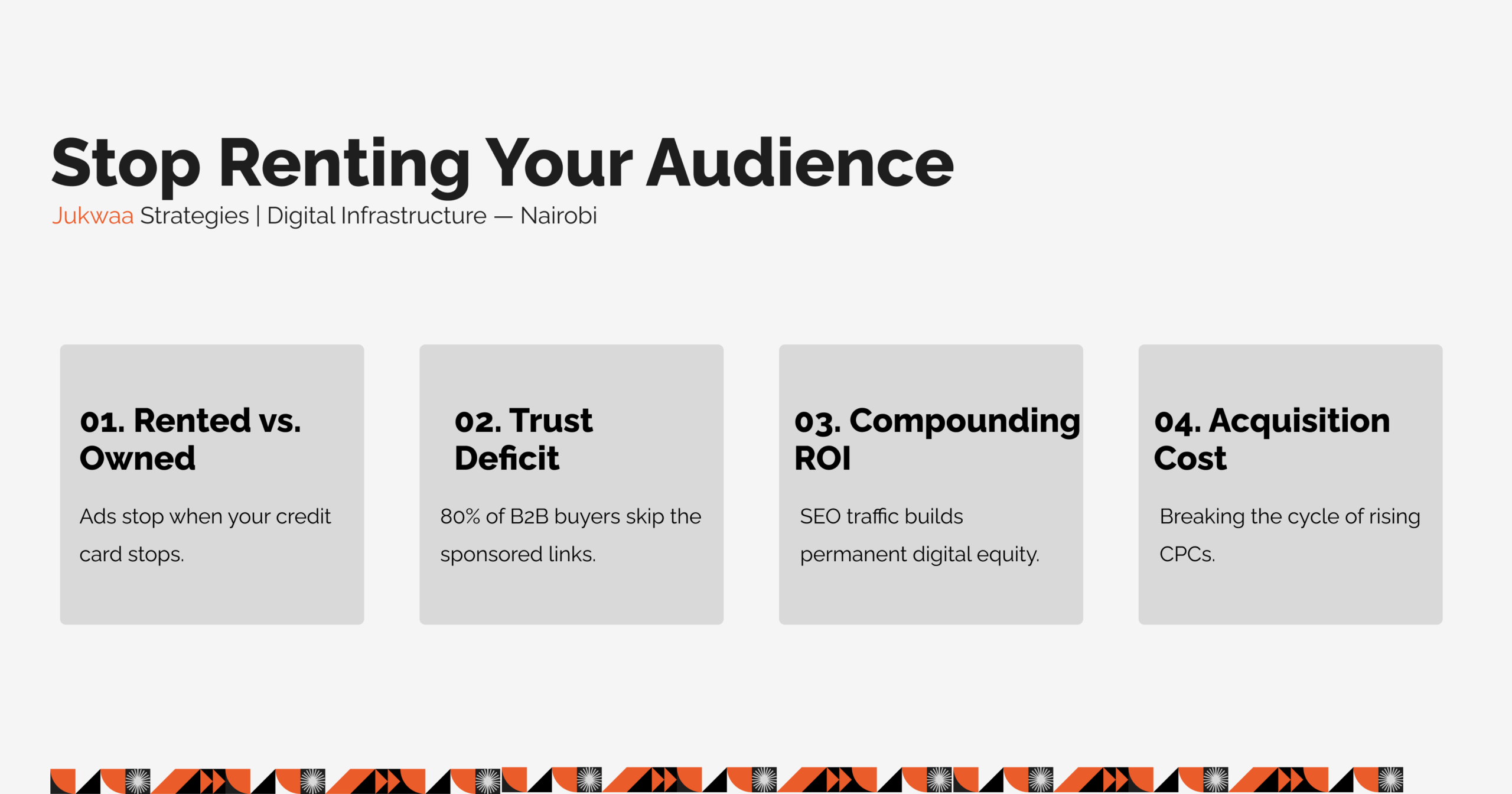
This creates a severe vulnerability in your business model: you are renting your market visibility. You do not own it. If a competitor decides to outbid you, your costs skyrocket overnight. Most dangerously, the moment your finance department cuts the marketing budget, your ads are turned off, your website vanishes from the front page, and your inbound lead generation drops to absolute zero. You have spent millions of shillings, but you have built zero permanent digital equity.
The SEO Reality (Owning Infrastructure): Search Engine Optimization is the highly technical process of structuring your website’s code, loading speed, and written content so that Google’s algorithm organically ranks you at the top for those same high-value keywords.
This requires an upfront capital investment in a specialized technical agency. However, once you secure the #1 or #2 organic ranking, you own that digital real estate. You can capture 10,000 clicks a month without paying Google a single shilling for the traffic. SEO transitions your marketing from a recurring operational expense into a permanent, high-yield capital asset.
2. Institutional Trust and the “Ad Blindness” Phenomenon
In the B2B sector and enterprise procurement, trust is the ultimate currency. How your brand appears in search results dictates how a procurement officer perceives your market authority.
Studies in digital behavior consistently show that over 70% of internet users actively scroll past the “Sponsored” ad results at the very top of Google, preferring to click on the top “Organic” results immediately below them.
Why? Because of a psychological phenomenon known as Ad Blindness. Corporate buyers are highly sophisticated. They know that absolutely anyone with a credit card, including an unverified, two-person startup, can buy their way to the top of the page via an Ad.
However, ranking organically at the top of Google signals undisputed market authority. It proves to the buyer that Google’s complex algorithm recognizes your enterprise as the most credible, established, and authoritative answer in the entire industry. For high-stakes corporate contracts, organic trust converts significantly higher than paid interruption.
3. The Generative AI Shift (Why SEO Evolved into GEO)
The debate between Ads and SEO has been permanently altered by the rapid rise of Artificial Intelligence in 2025 and 2026.
Corporate executives, foreign investors, and procurement teams are no longer just searching Google with simple keywords; they are asking complex, conversational questions to AI models like ChatGPT, Perplexity, Claude, and Google AI Overviews.
For example, a CEO might ask an AI: “Compare the top three corporate logistics partners in East Africa based on cold-chain capacity and regional footprint.”
You cannot buy a traditional PPC Ad inside a ChatGPT response. The only way to ensure your enterprise is cited, recommended, and validated by these powerful AI models is through a specialized form of SEO called Generative Engine Optimization (GEO).
GEO involves structuring your website’s backend data using advanced “Entity Schema Markup” so that AI machines can read, verify, and cite your corporate statistics as factual reality. If your enterprise is only investing in traditional Paid Ads, you are entirely invisible to the rapidly growing segment of buyers using AI for corporate due diligence.
4. The Mathematics of Customer Acquisition Cost (CAC)
When evaluating ROI, you must look at the timeline.
With Paid Ads, your Customer Acquisition Cost (CAC) remains flat or increases over time. If it costs KES 5,000 to acquire a B2B lead today, it will likely cost KES 6,000 next year due to inflation and competitor bidding.
With SEO, your CAC drops exponentially. You pay the agency a fixed monthly retainer. In Month 1, your traffic might be low, making the cost-per-lead high. But by Month 12, as you dominate multiple keywords and your traffic scales massively, your agency retainer remains the same. You are acquiring ten times the leads for the exact same fixed cost, driving your CAC into the ground and maximizing your profit margins.
5. The Optimal Solution: The Hybrid Execution Strategy
Is Paid Advertising entirely useless for B2B? No. The most sophisticated enterprises utilize a hybrid deployment model based on strategic timelines.
- Months 1 to 5 (The Incubation Phase): While your SEO agency is rebuilding your technical web infrastructure and waiting for Google to index the new authoritative content, you deploy highly targeted LinkedIn and Google Search Ads. This generates immediate, short-term cash flow and allows you to test which keywords actually convert.
- Months 6 and Beyond (The Domination Phase): As your organic SEO rankings secure the top positions, you systematically scale down your Paid Ad spend. Your Customer Acquisition Cost drops drastically because the bulk of your leads are now arriving for free through your owned, organic infrastructure.
The Executive Verdict
Paid Advertising is a short-term tactical maneuver. SEO and Generative Engine Optimization (GEO) are strategic institutional mandates. Stop renting your audience from Google, stop paying the click tax, and start building the sovereign digital real estate your enterprise deserves.
[Secure Your Digital Dominance with Jukwaa Strategies Today]