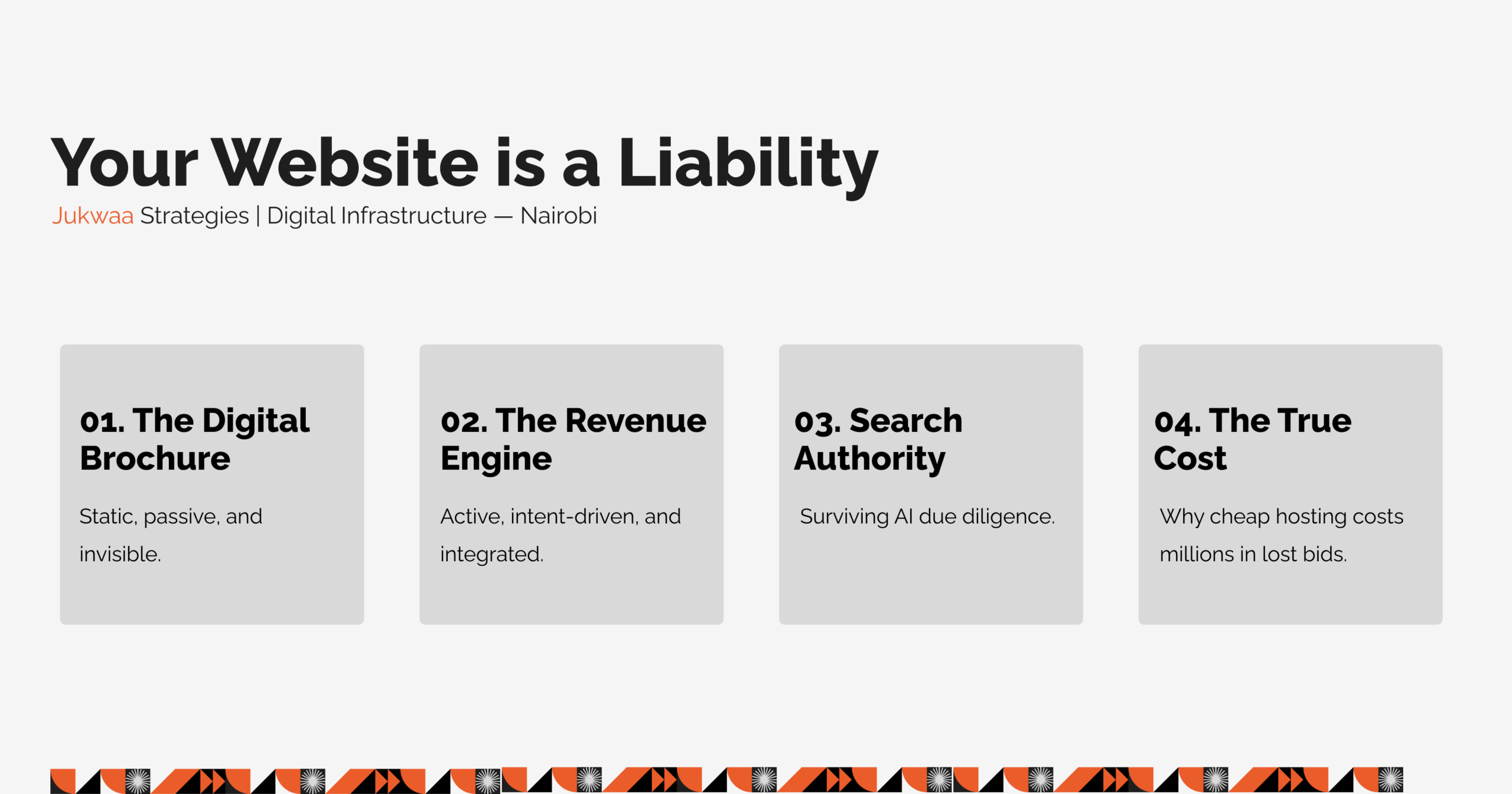
The Short Answer: In Kenya, website development costs range from KES 30,000 for a basic “Digital Brochure” built by a freelancer, up to KES 800,000+ for an enterprise-grade “B2B Revenue Engine” engineered by an institutional agency. A digital brochure is a static liability that simply lists your services and incurs hosting fees while generating zero leads. A Revenue Engine is a high-performance, secure digital asset engineered with Generative Engine Optimization (GEO), frictionless CRM integrations, and intent-driven landing pages designed to capture and convert high-value corporate procurement traffic 24/7.
For the majority of established B2B enterprises, manufacturing firms, and institutional agencies operating in Nairobi today, the corporate website is treated as a necessary, annoying administrative checkbox.
The typical corporate lifecycle involves hiring a junior developer or a cheap agency, launching a site with an “About Us” and “Contact” page, and then effectively abandoning the platform for five years until a visual refresh is deemed necessary by a new marketing manager.
This passive approach to digital infrastructure is actively destroying enterprise balance sheets across East Africa.
If your corporate website is not consistently bringing your sales team verified, high-intent commercial inquiries every single month, it is not a corporate asset. It is an operational liability. You are paying annual server fees, domain costs, and maintenance retainers for a platform that hands your market share directly to competitors who have invested in search dominance.
When budgeting for web development in 2026, corporate executives must understand the fundamental difference between buying a brochure and building an engine. Here is the definitive breakdown of what you are actually purchasing at each price tier.
1. The Anatomy of the “Digital Brochure” (KES 30,000 – KES 80,000)
How do you know if your enterprise is currently operating a digital brochure? It typically exhibits three severe structural symptoms that block commercial conversion.
The “Invisible” Search Profile
Digital brochures are built for people who already know your company name. If a user searches for “Rikara Group,” your website appears. However, new revenue does not come from people who already know you. New revenue comes from “Non-Brand” search intent. If a procurement officer searches for “commercial logistics partners in Nairobi” and your website does not appear on the first page, your site is functionally invisible. You are relying entirely on offline networking to survive.
The Friction-Heavy Conversion Funnel
Digital brochures rely on generic, high-friction lead capture methods. The most common offender is the generic info@yourcompany.co.ke email address listed in the footer, or a broken “Contact Us” form that demands ten fields of information without offering any immediate value. Corporate buyers do not have the time to send generic emails into a black hole.
Reporting on Vanity Metrics
When the marketing department reports on a digital brochure, they use “Vanity Metrics”, metrics that look impressive but have zero correlation to the balance sheet. They will report on “Total Monthly Visitors.” However, if 10,000 people visit your website and zero people request a commercial quotation, those 10,000 visitors are mathematically worthless.
2. The Architecture of a B2B Revenue Engine (KES 250,000 – KES 800,000+)
A Revenue Engine is built with a singular, ruthless focus: aligning with B2B buyer intent and removing all friction from the procurement and due diligence process. It is a capital asset, built on four non-negotiable architectural pillars.
Pillar 1: Sovereign, High-Performance Infrastructure
A revenue engine is never built on bloated, generic templates (like unoptimized WordPress themes or DIY builders like Wix). It is custom-engineered using modern web architecture to ensure lightning-fast load times. In 2026, Google explicitly penalizes slow websites. If your corporate site takes more than 2.5 seconds to load on a Kenyan 4G network, up to 50% of your B2B prospects will abandon the page. Speed is a conversion metric.
Pillar 2: Intent-Driven “Money Pages”
A digital brochure crams every service a company offers onto one long, confusing “What We Do” page. A Revenue Engine separates these into highly optimized, intent-driven “Money Pages.” If you offer Asset Finance, Trade Finance, and LPO Financing, each of these must have its own dedicated, 1,000+ word landing page. This is critical for Generative Engine Optimization (GEO) so AI models can confidently recommend your specific services.
Pillar 3: The “Value Exchange” Lead Capture
You cannot ask a corporate executive for their contact details without giving them something of immense value in return. Revenue engines utilize “Lead Magnets.” Instead of a generic contact form, you offer a highly valuable digital asset, such as an exclusive 2026 East Africa Supply Chain Industry Report, locked behind a simple form. The executive inputs their verified corporate email to download the data, and your sales team instantly captures a highly qualified lead.
Pillar 4: Frictionless CRM and API Integration
When a lead is captured on a revenue engine, it does not sit unread in a generic email inbox. The website is deeply integrated via APIs directly into the company’s Customer Relationship Management (CRM) software. The moment a prospect requests a quote, their data is routed instantly to the correct sales director, triggering an automated onboarding sequence.
3. The Institutional Verdict: Evaluating the ROI
For a Chief Financial Officer (CFO), the transition from a brochure to an engine requires a shift in financial perspective. You must stop viewing website development as a one-time marketing expense and start viewing it as a capital expenditure in your primary digital sales channel.
Can you hire a freelance developer to build a website for KES 30,000? Yes. But if your enterprise is doing KES 100 million in annual turnover, trusting your primary corporate interface to a budget freelancer is institutional negligence. Cheap websites lack security protocols, SEO architecture, and CRM integration, inevitably resulting in a hacked domain or total digital stagnation.
When evaluating the premium cost of a Revenue Engine, the calculation is simple: If your new digital infrastructure captures just one Tier-1 corporate contract or one massive supply chain tender that your old brochure would have lost, the infrastructure pays for itself tenfold in the first quarter of deployment.
[Commission a Digital Infrastructure Audit with Jukwaa Strategies Today]